
 Candi Barong is a Hindu remain, situated in Candisari village, Bokoharjo, Prambanan. The temple got its name from the kala decoration on the niches that look like Barong. Other name of this temple is Candi Sari Suragedug as mentioned in Ratu Boko Inscription date back 856 in Sanskrit alphabets and in Old Javanese language. The inscription mentions KIng Kumbaja or Sri Kalasobhava constructed lingga, Krttiwasalingga as companion of Dewi Sri, Dewi Suralaksmi as companion of Triyarbakalingga . And it is assumed that the mentioned building is Candi Barong. Continue reading Candi Barong, Central Java, Indonesia
All posts by admin
Candi Banyunibo, Central Java, Indonesia
 Candi Banyunibo is situated in the proximity of Ratu Boko Complex, at Cepit village, Bokoharjo, Prambanan, Solo, Central Java, Indonesia. This temple is 2 km away from Ratu Boko, in the farming area.
The temple was built in the 9th century, that constitutes of main temple facing west and 6 perwara temple in stupa shape on the south and east of the main temple. Each of the foundation is 4.80 x 4.80 meters. On the north of main temple, there is approximately 65 meters stone block wall. Main temple is estimated to have stupa roof to as the perwara temples, and therefore Candinibo temple is a Buddhist temple,
Main temple size is 15.325 x 14.25 meters and height is 14.25 meters. The temple body is smaller than its foot, that hallway surrounds the temple. On the west side, located the the entrance. On the wall, a relief of a lady is carved, and she was surrounded by children, and on the left wall depicts a man in sitting position. Both reliefs delineated Hariti, the goddess of fertility in Buddha and her husband Vaisaravana.
On the outer wall, stands Bodhisatva statuary, and on the north, east, south side there are protruding niches that are framed by kalamakara decoration.
Astana Giri Bangun Cemetery: Pilgrim to President Soeharto Tomb, Central Java, Indonesia
 Astana Giri Bangun Cemetery is located on the western slope of Mt Lawu, administratively situated on Karangbangun village, Matesih, Karanganyar Regency, Central Java, Indonesia. This is where second Indonesia president Soeharto and his wife buried. The cemetery was built under Astana Mangadeg, cemetery complex of Mangkunegaran Rulers. Astana Mangadeg is 750 m asl, while Giribangun is 666 m asl. There is a tunnel that connects both cemetery that can be entered by certain people and on certain days only. Continue reading Astana Giri Bangun Cemetery: Pilgrim to President Soeharto Tomb, Central Java, Indonesia
Sangiran Museum, Sangiran Prehistoric Site, Central Java, Indonesia
 Sangiran is a prehistoric site. Sangiran on the foot of Mt Lawu where Cemoro River flows to Bengawan Solo River.
In 1936, a paleontologist , Dr Von Koenigswald found fossils of here, in intact condition.The fossils is predicted to be 1,5 million years old. Beside prehistoric human, in 1934 discovered equipment from prehistoric time such as rock ax, and the like in large amount, more tha 1000 items. Those large findings were called as Sangiran Flakes Industry.
Later found lower jaw (mandibula) that was estimated as Meganthropus paleojavanicus, Pithecanthropus erectus or Javanese men. Indonesian researchers such as T Jacob and S Sartono were then interested to conduct research, and started excavations in 1960s.
Currently, approximately 65% of human prehistoric fossils in Indonesia discovered in Sangiran and the total is 50% of homo erectus population in the world. Sangiran draws scientists from all over the world.
According to research, Sangiran was a hill that was called as Kubah Sangiran (Sangiran Dome). The dome was passed by Kali Cemoro so this area eroded easily. The dome of 56 meters square was eroded that on the peak that creating depression.That depression revealed natural layers from 2 millions to 200 thousands years ago where experts found concise information over past life.
Every layer keep information from its soil, rock, fossils, and equipments. And not only fossils that lived on land but also sea creatures, as millions years ago this area was ocean. Because of geological activity, it rised and became land.
Since 1977, Government enacted Sangiran as cultural heritage area, and World Heritage UNESCO commitee assigned as world heritage 593. This site covers 56 meters square constitutes 3 districts in Sragen Regency, Kalijambe, Gemolong and Plupuh, and1 district in Karanganyar regency, Gondangrejo.
Sangiran has prehistoric museum that displays 2.931 fossils, among total collections 13.086 fossils it has. Other collections are kept in storage room.
Tawangmangu Waterfall, Karanganyar, Central Java, Indonesia
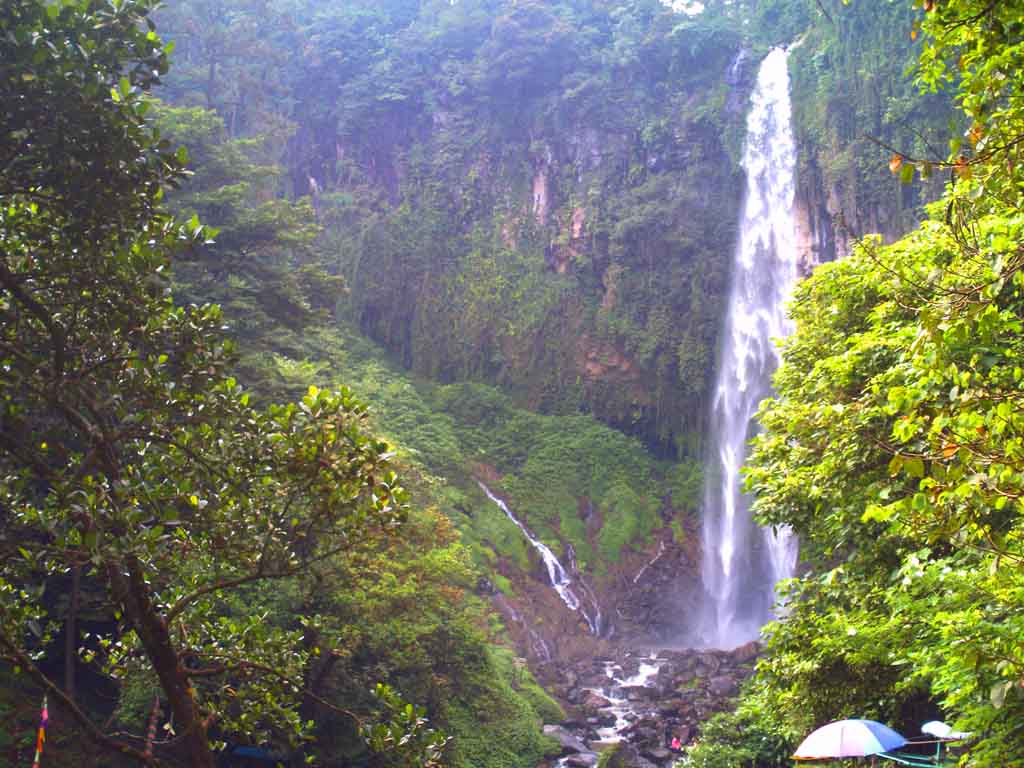 Tawangmangu is located on the foot of Mt Lawu,sure it has fresh air, and cold temperature at night. The panorama was amazing, with hills and farms with green color. Such an ideal place to refresh. Administratively it is located in Karanganyar regency, 36 km east of Solo. From Solo it is accesible, every 30 minutes there are public bus from Solo Bus Station. On the way to the waterfall, the scenery is splendid and and the road is winding.
Tawangmangu has been popular tourist attraction with natural environment, and even it is the home of monkeys. So beware of those naughty monkeys, do not leave your bag here, and hold your bag tight.
Grojogan Sewu waterfall is one of the interesting things to see in Tawangmangu. This 81 meters waterfall is on the elevation more than 1000 m asl. Grojogan means waterfall while sewu mean thousand. It is not that there ate 1000 waterfalls here, only one big fall. No explanation how this waterfall got its name.
Vastenburg Fortress : Witness of Dutch Interference in Solo, Central Java, Indonesia
 Vastenburg Fortress is located in the middle of Solo, and currently only the ruin overgrown by reeds that can be seen. The fortress was important, as it was the center of relation between Solo and Semarang. In XVIII-XIX, Solo was the center of trade, marked by the development of colonial city, and uniquely, Solo also has traditional atmosphere. There rae many remains of city nearby the fortress, such as St ANtonius Church, former Javasche Bank, Post Office, Resident House, Solo-Semarang road, European houses, and Societeit Harmoni. Continue reading Vastenburg Fortress : Witness of Dutch Interference in Solo, Central Java, Indonesia
Pasar Triwindu: Java Antique Market, Solo, Central Java, Indonesia
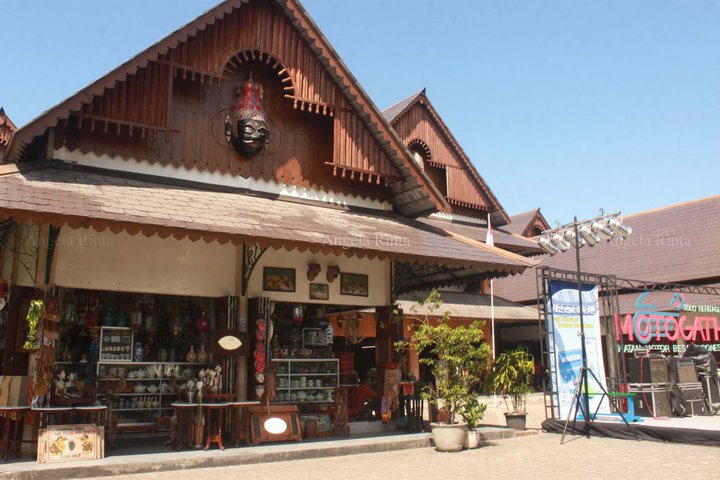 Pasar Triwindi is a traditional flea market that sell antique items, located in front of Mangkunegaran. Although it is a traditional market, th has more fresh and modern decoration though still retain its cultural design after restoration in 2010. Here, visitors can find coins, radio, keris, lamps, leather puppet, kid toys, wooden or bronze statue, and also reproduction of antiques. This market was names as Windujenar. Continue reading Pasar Triwindu: Java Antique Market, Solo, Central Java, Indonesia
Umbul Pengging/ Tirto Marto: Royal Bathing Place Boyolali, Central Java, Indonesia
 Umbul Pengging is located in Banyudono, 12 km from Boyolali, Central Java, Indonesia. This bathing building was used by King of Kasunanan Surakarta Hadiningrat, Sri paduka Paku Buwono X and his family. 2 days before fatsing month, event Padusan, is held here, beside other ritual on certain days such as soaking up to neck started on 24.00 to 03.00.
There are 3 bathing sections here, Umbul Manten, Umbul Ngabean and Umbul Dudo. Local legend tells that this bathing place is the remain from Ki Ageng Pengging, in the transition period from Majapahit Empire to Demak Emirpe and then later built by Keraton Surakarta and used only by royal family. Continue reading Umbul Pengging/ Tirto Marto: Royal Bathing Place Boyolali, Central Java, Indonesia
Gunung Kelud: New Born Lava Dome Phenomenon, Kediri, East Java, Indonesia
 Mt Kelud is one of the most dangerous volcano in Indonesia, located in Kediri, East Java, Indonesia. Since 15 century, GUnung Kelud has taken 15.000 lives. The eruption frequency is 15 to 30 years. In 1586, this volcano took 10.000 lives. While on the 2oth century, Gunung Kelud had erupted for 5 times in 1901, 1919, 1952, 1966 and 1990 and the total casualty was 5.400 lives. This mountain has new lava dome, appeared from its crater lake. The lake is completely replaced by this new dome, in 2007, the latest eruption. Mt Kelud is type of strato andesitic type volcano.
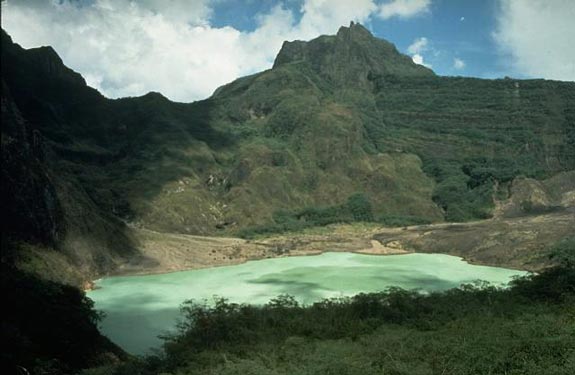 The end on September 2007, the activity of this volcano raised, and kept raising until November 2001, as signed by the increase of the heat of the crater lake, tremor quake, and the alteration of the crater lake color from green to cloudy white. The The Central Volcanology and Geology Disaster Mitigation, then determine the status of the volcano as ‘alert’ for inhabitants within 10 km radius more or less 135 thousand people in October 16 2007. But fortunately, the explosion never happened. After subsiding, it activity rised up again on October 30th 2007, and in NOvember 3rd 2001, round 16.00 the crater lake was 75 degrees Celsius higher from normal temperatur 40 degrees Celsius, this caused the temperature tool broken. The big amplitude of tremor quake, higher than 35 mm, required the controller officer evacuated. But there was no eruption. As the high activity, the volcano smoldered white smoke stem from the middle of the crater lake and the followed by lava done since November 5th 2007 and kept on growing larger up to 100 meters width. Experts cited that this dome had blocked the magma flow that the explosion did not happen at all. This type of eruption is known as effusive eruption, not an explosion. The energy of the eruption was used to push the lava dome of the previous eruption in 1990. Since the lava phenomenon, the activity was down, and later on November 2007, the status was lowered.
In 2010, the activity was still high but stable, the height of the new baby volcano was 250 meters, and width 465 meters and temperature was 53.8 degrees Celsius. And the lava dome is predicted to be still growing.
Though the green crater lake was gone, the new kid on the Mt Kelud is such an interesting phenomenon to see. This dome is surrounded by higher slope and peaks of mt Kelud. Well, no wonder lava took to appear on the former crater lake, as it was easier to break.
Pangeran Diponegoro Museum, Magelang, Central Java, Indonesia
Pangeran Diponegoro Museum is located at former complex of house of Kedu Resident at Jalan pangeran Diponegoro, No 1, Magelang. In one of the room here, a historical meeting between Pangeran Diponegoro and General De Koock that represented Holland was held, and witnessed by Resident Kedu, Major De Strude, Lieutenant Colonel Roest and Captain Roes as translator. The meeting was held in 28 March 1830. But De Koock was fraudulent that Pangeran Diponegoro jailed while according to agreement he suppose to leave save and sound. Continue reading Pangeran Diponegoro Museum, Magelang, Central Java, Indonesia