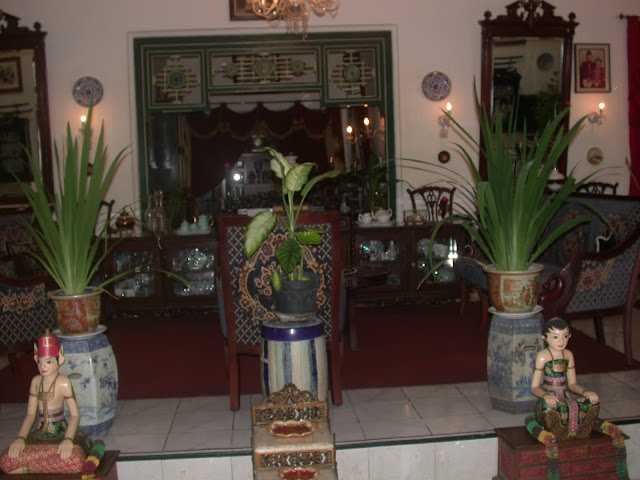
 nDalem Joyokusuman is part of Sultan Palace, Kraton Ngayogyakarta Hadiningrat. The house is set with Javanese architecture and function. Currently, this house is used by Gusti Bendoro Pangeran Haryo (GBPH) Haji Jojokusumo and his family. He is one of Sri Sultan Hamengkubuwono IX with Kanjeng Raden Ayu Widyaningrum and also brother of Sri Sultan Hamengkubuwono X. He is the Kawedanan Hageng Panitrapura and as Narpa Cundoko.
This building was established in 1916, stem from Sri Sultan Hamengkubuwono VIII initiative. The first resident of this house was KRT Condrokusumo, the nephew of Sri Sultan Hamengkubuwono VII. Later occupied by Gusti Bendoro Haryo (GBPH) Bintoro, brother of Sri Sultan Hamengku Buwono IX that became Narpo Cundoko Dalem. GBPH Bintoro ever in charged as Consulate General Republic Indonesia in Ontario and the first president of Lion Club Indonesia.
nDalem Joyokusuman has 7 rooms, separated by wall called as Cempuri. The seven rooms are pendopo, peringitan, senthing tengah (middle room), sentong tengen (right room), sentong kiwo (left room), gadri dan pawon (kitchen). This plan delineates that man is the main ruler of family and woman is the mother of the household. Both should form a conducive situation to create better generation.
PENDOPO is the front part of the house, used as place to accept guests. Currently, this part is utilized as Gadri Restaurant and accommodate other activities such as batik. There is a cage standing at Pendopo called Kurungan Tedak Siten used in traditional ceremony and old clock gift from Ngarso Dalem SDISKS Hamengkubuwono IX to KTAy Widyaningrum, mother of GBPH H Yojokusumo.
PERINGGITAN is the second room behind pendopo separated by a big door in the middle and 2 doors on left and right side. Peringgitan was used as living room. Inside peringgitan there is a big umbrella of Payung Kebesaran pangeran used in palace ceremony. There are also displayed gifts from Ngarso Dalem SDISKS Hamengkubuwono IX toward KRAy Widyaningrum
Sentong Tengah is middle room behind peringgitan, where traditionally placed pendaringan or pasareyan tengah, where equipments and accessories are placed, including loro bloyo statues, accecories of Javanese hair; a floral konde used in palace ceremonials. Here also displays Kiswah, gift from King Fath from Saudi Arabia. Senthong Tengah was where Tampa Kaya ritual after Panggih Ceremony in wedding procession held. Tampa Kaya is the symbol of the eagerness of husband to fulfill the needs of wife and family.
Sentong Tengen is a closed room located next to Sentong Tengah. This room was the bedroom of GBPH H Joyokusumo, where there is a big bed from the late KRT Condrokusumo, the nephew of Sultan Hamengku Buwono VII.
Sentong Kiwo is a closed room located on the lest of Senthong Tengah. This room was used as guest room. Currently, the room is used for museum with KRAy Widyaningrum bed, also the bed of Sri Sultan Hamengku Buwono IX in display. The bed is furnished with two big pillows, two bolsters, two gembuk and two small pillows.
Gadri is a big room behind Senthong Tengah and separated by a big sliding door. This room is used as dining room for family and relatives and to welcome guests in Royal Dinner and Lunch for Gadri Resto. The rear of the room has small pendopo used to place gamelan of nDalem Joyokusuman.
Pawon is family kitchen. This room was important in Javanese house, as dining, drink were presented from here.

 Dalem is a term for prince house. This house was built in 1855, in the period of Sri Sultan Hamengku Buwono V and used first by KRT Suronegoro until he died in 1911. This house is now named as Ndalem Kaneman, as the current owner of the house, GKR Anom Adi Brata, the first daughter of Sri Sultan Hamengku Buwono IX and KRAy Pintokopurnomo. Beside utilized as residence, this house also used to accommodate various of activities such as dancing course managed by Among Baksa institution, and often used to entertain foreign visitors with Javanese dancing.
 Hati Kudus Church in Ganjuran is located 20 KM from Yogyakarta city. The green rice paddy, and pines will welcome visitors in Ganjuran Village, where the church located. This church is a product of Javanese-Catholic acculturation.
 One of the heritage of Chinese etnhic in Yogyakarta is Klenteng (Temple) Gondoman, named as Buddha Praba Temple. It is situated at Gondoman region, notably at Jalan Brigjend katamso 3, Yogyakarta. It is an important historical building for the development of Chinese in Yogyakarta.
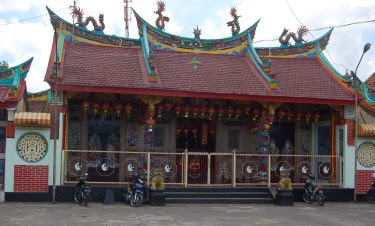 Klenteng (Temple) Poncowinatan is the common name of Zen Ling Gong Temple located at Jalan Poncowinatan 16, Kranggan, Yogyakarta.
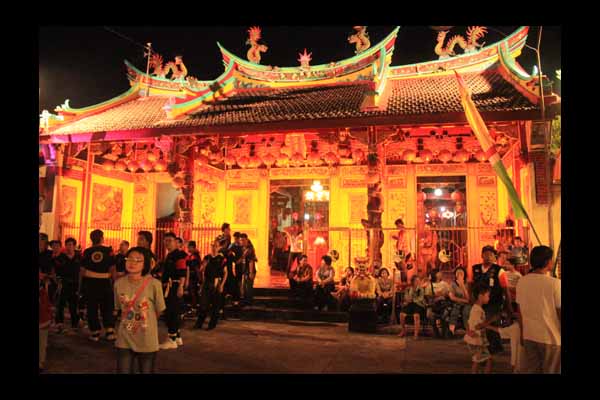 In 1907, Chinese built first chinese school in temple area names Tiong Hoa Hak Tong, under Tiong Hoa Hak Tong in Batavia. This temple was ever lent by some temple area lent by Temple External Independent Institution. THHT building stands on the west pagoda, since 1923, also known as the Chinese Temple, and then divided into three parts: the middle for worship area covering 2000 sqm, the west for school covering 1200 sqm, and the rest is sport and cultural area. In 1940 THTT halted to employe the asset of the temple as it failed to compete Holland Chinesche School (HCS). HCS is an East Indies school to demise THTT, as it advance its existence is deemed evoking nationalism spirit. Finally THTT returned the building to the temple and used as dorm for temple clergies and caretaker. The advent of Japanese occupation in Indonesia forced all Dutch schools closed, and in reverse Chinese school opened. Temple assets then lent to Chinese Community School (Ri Re Zhong Hua Di Yi Xiao Xie, or abbreviated as Di Yi Xiao) that was managed by Education institution Chung Hwa Yogyakarta. The management kept changing since Dutch established HCS (Holland Chinese School) that later banned School management by Chinese ethnic. In 1970, the management of the school was Yayasan Budaya Wacana (YBW)
 Poncowinatan Temple is managed by Yayasan Bhakti Loka. It has many interesting distinctions that other temples. This temple is one of cultural reserve of Yogyakarta, stated officially by Regulation of the Minister of Culture and Tourism Number PM.07/PW.007/MKP/2010 signed by Jero Wacik,Minister of Culture and Tourism.
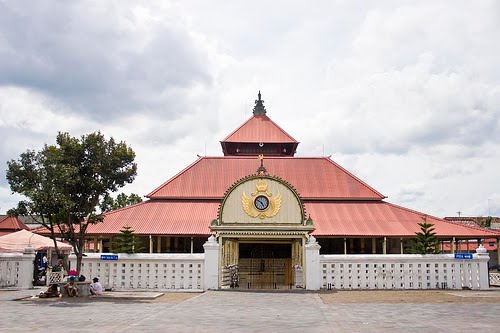 Masjid Agung or The Great Mosque of Yogyakarta is locted at the center of capital, built in the period of Sri Sultan Hamengkubuwono I. The city plan of Yogyakarta is using taqwa (piety) concept, so the spacial composition was formed based on borders of 5 sultanate mosques on four directions with the great mosque as the center. The placement of the Tugu (monument)- Panggung Krapyak as the main element of the space. This composition placed Tugu-Keraton-Panggung Krapyak as one line.
 This traditional house was built by RL Sosrodigdaya II (palace official and also village chairman) and finished in 1860. After he died, the house was used by his son RL Sosrodigdaya III, later known as Rl Kawindrodigdaya for intern mutation and then promoted as KRT Kusumabudaya. The traditional Javanese style can be seen from the room plan, building material, pendopo in front of the house, and a well at the front yard and the roof shape is joglo and limas an at the main house. The yard is set with garden with fountain, 200 plant species and item collections.
 Sendangsono is located at Banjaroyo village, Kalibawang, Kulon Progo, Yogyakarta Indonesia. It is a site where pilgrimage visit Marry gave that is managed by St Marry Lourdes Parish in Promasan, northwest of Yogyakarta.