
 Bintaran was an alternative settlement region for Dutch staying in Indonesia evolving after the Loji Kecil (Small Loji) was not adequate anymore. The location is not far from Loji Kecil that various facilities could be accessed easily from here. Just like the typical building if Javanese-Dutch style, the buildings here have thick walls, tall main door and tall windows. Not only the residence of Dutch, this are also favourite place for Javanese Royal Families. Now this area is used as architecture laboratory for several universities.
Before evolving as Indisch settlemet, Bintaran was known as the location od Ndakem Mandara Giri, the house of Pangeran Haryon Bintoro, one of the descendant of Ngayogyakarta Hadiningrat. This settlement estimated to evolve since 1930s marked by the property, church, and jail construction. Dutch resided in Bintaran were officers and sugar factory employees.
Just like other Indisch village, this region is rich of Europan buildings, though it has distinct style than buildings in Loji Kecil or Kota Baru Region. The yard of buildings here are more spacious, while the front part of the houses are smaller in size, they have more pillars and the front doors are in krepyak style, and the inner door is completed with glass.
The building that is enchanting architecturally and they are interesting historically in this area is Ndalem Mandara Giri. Its architecture is a blend of Dutch and Javanese.
Ciri Jawa terlihat dari adanya pendopo yang bahan-bahannya khusus didatangkan dari Demak pada tahuicallyn 1908. Sementara, ciri bangunan Belanda terlihat dari ruangan yang lebar dan berdinding tinggi serta jendela khas Belanda yang besar dan memiliki dua daun. After left by Pangeran Haryo Bintoro, the building was utilized as keris room exhibition, and after that it was empty since 1997. Other historic building is Sasmotaloka, located on the left of Jalan Bintaran. It was built in 1890, used as the residence of Puro Paku Alam accountant, Wijnschenk. It was also the home office of General Soedirman, and later as the residence of Kompi Tukul after the independence.
Biology Museum that is situated at Jalan Sultan Agung was utilized as the residence of Pakualaman Military Inspector. The house of Henry Paul Sagers is currently used as Fire Fighters Quarter. The current Wirogunan prison was old dutch prison.
The church of Bintaran is very unique, as the church was built according to a Javanese idea of uncomfortable of the way H van Driessche SJ, a Dutch-Indonesian, who was in charge for the construction of the church, prayed. The church was erected in 1931, and called as St Joseph Church, in related with the prayer of Driessche to Santo Yusuf when he was in difficulty finding the location for the church.
 Goa Cerme is located at Srunggu village, Selopamioro, Imogiri, 20 KM from city of Yogyakarta. The road to the location is good, though winding and steep,but the landscape is very nice.
 Pulo Cemeti is not an island (polu in Javanese), but a ruin of heritage located behind Ngasem market. As the height of the location, people use this site to take a look at Yogyakarta view.From here Yogyakarta looks beautiful with houses, and trees with the breeze. From here, visitors can enjoy jogja sunrise and sunset.
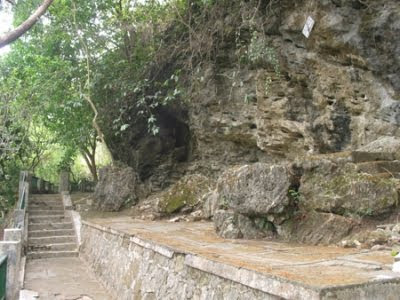 This cave is located at Guwosari Village, Kecamatan Pajangan, Bantul INDONESIA. The cave is the witness of Prince Diponegoro struggle and his men, as it was used as the base camp for guerilla fight against Dutch. In this cave area, Prince Diponegoro set strategy and tactics, and discussion with his men to assault Dutch. During camp in Selarogn Cave, Prince Diponegoro had assault Dutch 3 times, on July 25th, October 3rd, and October 4th 1825. That war between Prince Diponegoro and Dutch is known as Java War, from 1825-1830.
 Before named as Condrokiranan, this house was named as Wijilan. It was the residence of Adipati Gusti Pangeran Aryo Mataram that later was inaugurated as Sri Sultan hamengkubuwono III. And the house was taken over by Gusti Pangeran Wijil, and the his son KRT Wijil, so this house is known as Ndalem Wijilan. Then the house was given to BPH Joyowinotobefore sold to the last owner GKR Condrowinoto, wife of KPH Danurejo, the last patih of Yogyakarta. Until today this house is popular as Ndalem Condrokiranan. This house now used as Sono Budoyo Museum Unit II, to accommodate the more collections of Museum Sonobudoyo I. One of the museum collections are Pakualaman tandu, gamelan, handicraft, and crops of agriculture and plantation in Yogyakarta.
 This house was built by Sri Sultan Hamengkubuwono VII (1877-1921) initially occupied by Dewi, the 38th daughter of Sri Sultan HB VII from his queen GKR Kencono. Currently the house is ised as residence for GBPH Yudoningrat, the 13th daughter of Sri Sultan HB IX from KRAy Hastungkoro. The house was ever utilized as Literature faculty of Gajah Mada University in 1960s, before the university moved to Bulak Sumur. There are 35 ‘ngidung’ house and several buildings units in this ndalem complex that later used as Farmacy School and Chemist School since 1960s. Since 2987, PORDASI Secretary (The Association of Indonesia Equestrian Sport ) is based here. The house can accommodate wedding party and other special events. There is horse carriage that can be rent.
 This house was built in 1865, by Sultan Hamengku Buwono VI and erected as house his royal prince, Pangeran Adipati Anom. After the prince coronation, this house was occupied by his brother GPH Mangkubumi, so it is more popular as Damelm Mangkubumen. After Mangkubumi died, his brother GPH Buminoto replaced him and live in the house until 1928. The house was used by General Sudirman in Dutch Military Aggression II. Since 1983 until today, the house has been using by Widya Mataram University and Mataram High School.
 Dalem pakuningratan was built in 1877-1921, gradually in the period of Sri Sultan Hamengkubuwono VII, to be used for Prince Purboyo, the royal prince that later was coronate as Sultan Hamengku Buwono VIII. This house has been renovated 3 times. First in 1926, as ordered by Sultan Hamengku Buwono VII, when pendopo was connected to peringgitan. Second, in 1928, when rear terrace was built. And the last in 1939, when all cement floor changed to 20×20 meters tile in yellow and gree motive and change the door paint from grey to green.
 Though the condition of this cemetery is not as well as people imagine, Peneleh Cemetery is the oldest modern cemetery in the world. The site plan is set in blocks, and it has record about the bodies, family tree, even the standard crematorium facility had been built since the cemetery established. This Cemetery is established in 1814, with official name as De Begraaflaats Peneleh Soerabaja located at Jalan Makam Peneleh Surabaya. It was built much later after Kebon Jahe Cemetery in Jakarta in 28 September 1795. But Peneleh is the oldest modern cemetery among the others in numerous countries, such as Fort Cannin Park (1926) in Singapore, Le Chaise Cemerety od paris, Gore Hill Cemetery (1868) in Sydney, Arlington National Cemetery in 1864, Mont Auburn Cemeteryof Cambridge in 1831 that was said to be the oldest modern cemetery in the world. Among those other old cemeteries, the condition is the worst.