Masjid Syuhada is located at Jalan I Dewa Nyoman Oka No.13 Kotabaru, Yogyakarta, Indonesia. This mosque is witness of moslem struggle to gain Independence. This mosque keeps candrasengkala and as well as the commemoration of Indonesia Independence Proclamation that it is delineated in important buildings such as 17 steps of stairs, 8 side pillar shape on its gate and four lower cupolas and 5 upper cupolas (17 -08-45 or 17 August 1945, Indonesia Independence Day)
The building has 3 floors, the lower floor is used as learning room that is equipped with 20 windows that is expected to be reminder of 20 natures of God, Allah. At the second floor is used as prayer room for women, where there are two pillars, that support the building delineate 2 faiths of human. While at the third floor, is the main prayer room, for Friday prayer at the priest (imam) room (mihrab), there are five ventilation that represent 5 pillars of Islam.
In August 17th 1950, the Mecca direction was set on ground, currently a building stands there. On 23 September 1950 or 11 Dzulhijah 1369, on Aidul Adha, Sri SUltan HB IX as Republic Indonesia Defence minister, officially initiated the construction of the mosque. Two years later on 20 September 1952, the whole building was finished and it was officially opened in Islam New Year, 1 Muharam 1372.
The mosque erection was intended to fulfill the necessity of Moslem generally and especially to give honor to the struggle of Yogyakarta moslem that support the community, nationa and RI. And the mosque is also a monument to commemorate heroes died in defensing Indonesia Independence.
The mosque is a blend of various architectural style. It has Persian, Indian and Indonesian style. The round dome in the middle is the main dome, surrounded by small domes on its corner. It has 3 floors that gives the opportunity to the moslem community to hold various activities.
 People will answer spontaneously the specific food of Yogyakarta is gudeg. Gudeg can be found on every corner of Jogja, and Jalan Wijilan is the center of gudeg in Yogyakarta.
 Puro Pakualaman is a historical building and inherent to the erection of Kasultanan Yogyakarta Hadiningrat.Puro Pakualaman is a adipati palace where Paku Alam generation dwell. This palace was built in the 19th century, located at Jalan Sultan Agung, 2 km east of Sultan palace. According to the function as Adipati palace, Puro Pakualaman was where Adipati Keraton Yogyakarta, entitles as Paku Alam, resided.Adipati is official position same as prime minister.
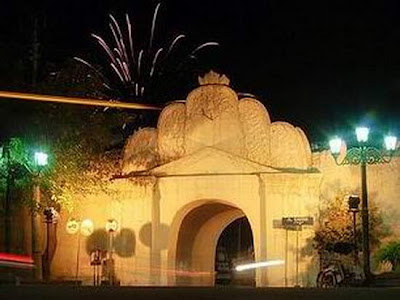 Plengkung is gate in Javanese. According to history, Sultan palace had five gates on its fortress;
 Alun-alun Selatan is the south square of Sultan Palace. This square is also named as Pengkeran. Penkeran derives from pengker a refine word (krama) of mburi means rear or behind. It is named so as the location of the square is behind the palace. This square is encircled by square wall with 5 gates, one at the south , 2 at the east and 2 at the west. Between the gates at the western wall there is ngGajahan, a cage for Sultan’s elephant. Around the square is overgrown with mango tree, mangifera sp, and kweni (Mangivera odoranta). And two pairs of banyan trees; one pair in the middle called as Supit Urang (shrimp claws), and one pair on the left and right side of gate that is called as wok, derives from brewok (beard). From the south gate there is a passage called as Gading that connects to Plengkung Nirbaya.
 Not every people know that Sumur Gumuling is located on the same complex of Taman sari, that actually was an underground mosque used in the glorious day of Keraton Yogyakarta.It is easy to reach Sumur Gumuling from west and east gate. Those gates are the end of Sumur Gumuling. The west gate is currently only collapse, while the east is still in good condition and can be passed.
 There are approximately 5000 graves in Kembang Kuning Cemetery, Surabaya. This is where Dutch soldiers died. Those soldiers convert various of religion, from Christian, Buddhist, Jewish and Islam. The blocks are set according to the dead’s religion. According to the caretaker ARM Soekarjono, there was only one Jewish soldier buried there signed by stars.
 Though the condition of this cemetery is not as well as people imagine, Peneleh Cemetery is the oldest modern cemetery in the world. The site plan is set in blocks, and it has record about the bodies, family tree, even the standard crematorium facility had been built since the cemetery established. This Cemetery is established in 1814, with official name as De Begraaflaats Peneleh Soerabaja located at Jalan Makam Peneleh Surabaya. It was built much later after Kebon Jahe Cemetery in Jakarta in 28 September 1795. But Peneleh is the oldest modern cemetery among the others in numerous countries, such as Fort Cannin Park (1926) in Singapore, Le Chaise Cemerety od paris, Gore Hill Cemetery (1868) in Sydney, Arlington National Cemetery in 1864, Mont Auburn Cemeteryof Cambridge in 1831 that was said to be the oldest modern cemetery in the world. Among those other old cemeteries, the condition is the worst.
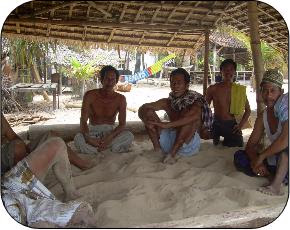 Usually enjoying nap or sleep at night, people will choose a pillowy bed and pillow in a comfortable room, but no guarantee that they will have deep sleep. And actually sleep quality not always have anything to do with the location and the visual quality of sleeping area. Look at the homeless, they enjoy their sleep well in front of shops or under bridge. Sleeping is manifestation on human need to rest after activities.
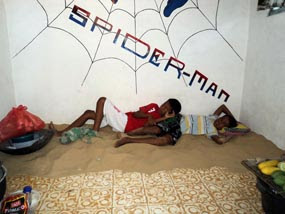 As littoral community, everytime they are departingto or returning from ocean, they always encounter sands at the beach, that their daily lives are surrounded by sands. The sand in those villages are not only on the beach but also deeper to the village complex, even their yards are span of sands, if not built in cement or other materials. They enjoy the sand overlay morning, afternoon and even in the evening. At noon they find that the sand gives them cool feel to their body. And at night, the sand gives them warmth. The sand in this area is very adaptive and as if it is automatically adjust its temperature to the air temperature. When the air is hot, sleeping on sand chilling them, and when the air is cold, sleeping on it warming them. Sands are utilized to relax, spend time with family or neighbors, and even to sleep.
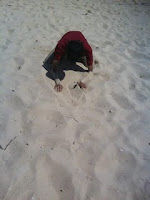 After tired of fishing on ocean, usually they roll their body on sand as they bathe with sands, after that they feel fresh and their tiredness is just disappear. Thats what they tell about the virtue of the sand. Are there any mineral in the sand there? Only experts can answer. But the sand in Sumenep are usually soft and clean. Most of coast in Sumenep are covered by sand such as Slopeng Beach that has deserts or Lombang Beach with span of sand among Casuarina Equisetifolia. The sand here is different than in other region for it has soft texture, shiny, pastel color and clean.