
All posts by admin

Museum Affandi, The Maestro Works and Humbleness, Yogyakarta, Indonesia

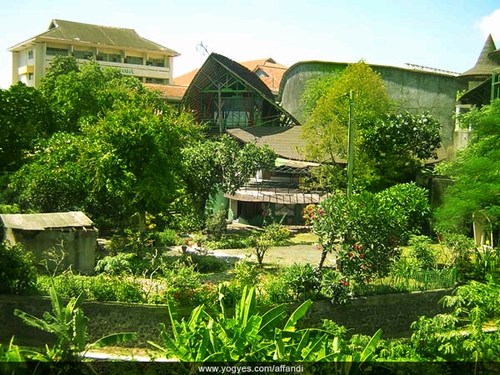
This museum is located on the west of Gajanh Wong river, at Jalan Solo, formerly the residential of Affandi, Indonesia maestro. The complex covers 3500 sqm and the museum shows the low profile of the maestro. The roof of the gallery resembles banana leaf that was designed by the maestro himself. The construction was done gradually, THere are 3 exhibitions rooms, a residential, and family room with cow-cart design that was made for his wife request, Maryati, after she was sick and could not step stairs to the main house. Initially, Maryati wanted a caravan, but Affandi realized her wish with cow-cart.

Gallery I was built in 1962 covers 314,6 sqm and officially opened by Director General of Culture, Prof Ida Bagus Mantra in 1974. The gallery displays Affandi’s works from his early career till his last days of scetches,  watercolor, and oil on canvas.His favorite car was Colt Gallant made in 1976, that is also displayed here. This car is modified in shape of fish. There are medals and awards from Indonesia or abroad such as Doctor Honoris Causa from National University of Singapore in 1974. Stampls collections of the maestro is displayed here as well.

Inside Gallery II, that was finished in 1988 and officially opened by MInister of Education and Culture Prof Dr Fuad Hassan, there are painting works of Kartika that are for sale and exhibited. In this gallery, you will find out why Affandi apply paint from its tube directly, without pallet to blend color. On skectch ‘Ganbar Sendiri’, the maestro wrote ‘I apply tube paint on canvas, and  then swept with hand or pencil. I found this method and i use this method to ease and fasten the work. Not because it is fast, but for the flowing of emotion uninterrupted. If i use pallet,  then mix colors on it, that interrupts expression flow, and gave chance for brain to think’ (free translation)

Gallery III displays works of Kartika, and Rukmini, the daughters of the maestro, and needlework of his wife, Maryati. The gallery was finished construction in 1997 and officially opened by Sri Sultan Hamengkubuwono X. This gallery has 3 floors where the lowest floor is used to store collections, the first floor for exhibition room and the second floor for treatment room.

Affandi and his wife’s tomb are located on the complex. Affandi died in May 23rd 1990 and chose a space between Gallery I and Gallery II as his resting place, surrounded by his works.

The comples shows the humble of the maestro. He wears sarong and white undershirt that sometimes was holey here and there and smoked with his favorite pipe.  Sometimes with his humble outfit he walked to see small food stall sellers on street, and people did not consider that actually he was a world class painter. His paintings were ever sold on Christie’s and Sotheby’s  Auction.
Monjali, Monument Jogja Kembali, Yogyakarta, Indonesia

Monumen Jogja Kembali or popular as Monjali was built in June 29th 1985, signed by traditional ceremony of burying bull head and officially the construction started by Sri Sultan Hamengkubuwono IX and Sri paduka Pakualam VIII. The idea was delivered by Kolonel Sugiarto, as the mayor of Yogyakarta.

Jogja Kembali was an icon of historical event when Dutch withdrew its troops from Yogyakarya, the capital city of Indonesia in June 29th,1949 as the symbol of the end of colonialism.

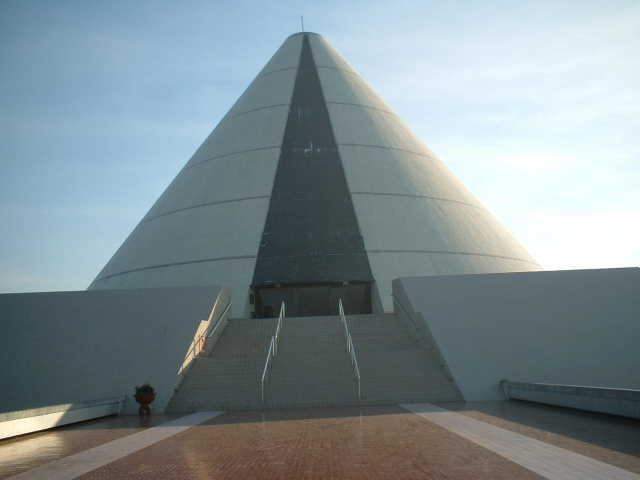
The monument has cone shape, consists of 3 floors and the construction was finished in 4 years and officially opened in July 6th 1989 by President Soeharto. This 31.8 meters high monument is administratively located in Jongkang village, Sinduadi. Mlati, Sleman. The cone design symbolizes mountain, the source of fertility beside also conserve and maintain pre-historic culture of ancestors. The location was chosed for Yogyakarta culture. The monument is located on an imaginary line that connects Gunung Merapi, Tugu, Kraton, Panggung Krapyak and Parang Tritis beach. This line is known as macrocosmos axis or Big Axis of Life. The imaginari spot in the monument is at the tha flag pole in the third floor. On the monument yard there is a cannon with 60 mm caliber made in Russia, while the front yard there is the replica of planes in the incident of Jogja Kembali.

In front of the monument there is a memorial with heroes name list, 422 heroes that died in Wehrkreise III region from December 19th 1948 to June 29th 1949, Krawang Bekasi.

The monument is surrounded by pond. On the first floor there are 4 rooms that displayed replicas, photos, document, heraldic, weapons, and emergency kitchen that delineate the atmosphere of physic war in 1945-1949. Visitors can see General Soedirman palanquin, uniforms, horse cart. One room at the first floor is used for library saving collections of Independence struggle of Indonesia and can be utilized by public. The multi-functional room is in the middle of the first floor equipped with open stage. Every Saturday, Sunday this room hosts various of attractions such as classical dance, gamelan, and patriotic and nostalgic song. Beside that wedding reception, seminar, graduation and other events can be held here.

The second floor there are physical struggle reliefs and diplomatic struggle of Indonesian since August 1945 till December 28 1949. The reliefs are General Mayor Meyer that threatened Sri Sultan Hamengkubuwono on March 3rd 1949 and other leaders to return to Yogyakarta, Sri Sultan HB IX stated that Yogyakarta was part of Republic Indonesia, Independence Celebration at Kraton Yogyakarta.

Inside the second floor there are 10 diorama of physical and diplomatic struggle since19 December 1948 to 17 August 1949 with life size. The diorama is started with Dutch Military Aggression to enter Yogyakarta to regain control over Yogyakarta. The Dutch troop was led by Captain Van Langen that succeed to take over Maguwo airport (Now Adisucipto airport) on 08.00. At 16.00 Dutch took over the entire city and other important buildings such as President Palace, Benteng Vredeburg. From that day on, the struggle to regain Republic Indonesia began. The diorama showed the patriotism of General Soedirman who was very ill of lung sickness, but he kept leading physical battle though President Soekarno asked him to stay with him.

March Assault on March 1949 led by Lieutenant Colonel Soeharto for political, psychological and military reason where Indonesia spread the news of its existence to the world. This assault was spread by AURI by PC 2 code at Banaran, Playen, Gunung Kidul, and even reached Burma, India and RI Representative in UN. Sri Sultan HB IX coordinated the withdrawal of Dutch troop in 29 June 1949 and in 7th May 1949 it was ended with Roem-Royen Agreement.

The third floor is Garbha Graha or the silent room. There is flag pole with Sang Merah Putih or The Red and White in the middle of the room. There is a relief of hand as physical struggle and diplomatic struggle as hand holding pen.

The monument opens from Tuesday to Sunday from 08.00 to 16.00. On school holiday it opens from 08.00-14.00 on Monday.

Pasar Semawis, Chinese New Year Event, Semarang, Central Java, Indonesia

Pasar Semawis is located in Semarang Chinese Town, Central Java, Indonesia that is undertaken  few days before Chinese New Year and this has been an annual event since 2004 when Chinese new year is legalize as national holiday in Indonesia.
The market is full of chinese ornaments, and other Chinese traditional performances and cultures such as classics opera, wayang potehi, barongsai, calligraphy, and Chinese medical consultancy. This annual event is organized by Kopi Semawis, Community of Semarang Chinese for Tourism and supported by Central Java Tourism Department, Semarang Government and other parties.

There are many kinds of culinary that cab be enjoyed at Pasar Semawis, from Indonesian to Chinese food, like pig satay.  Or any beverages such as Wedang ronde, tea, ice , wedang kacang tanah. And sure you can find Semarang special food, lumpia (spring roll)

Not only culinary, it has karaoke section, that specially plays mandarin songs. Other sections are booth sell fruits, clothing and accessories.


Al Akbar Mosque: The Beautiful and The Biggest Mosque in Surabaya, East Java, Indonesia

Al Akbar Mosque was built on land covering 11.2 hectares, constitutes of 28.509 sqm building with capacity of 28.509 sqm. This mosque was projected to embodied concept of mosque in a universal meaning, as Islamic center for multidimension roles with religious, cultural, educative mission, including religious attraction, to develop Islam world. This mosque is another landmark of Surabaya and symbolically enriching Moslem world, and to beautify Surabaya image for foreign countries.

The Mosque was constructed as initiated by Surabaya city mayor, Mr Soenarto Soemoprawiro. The official construction was officially started by vice president Tri Sutrisno in August 1995, and the real construction was started in September 1996. On 10th November 2000, the mosque was officially opened by President Abdurrahman Wahid.

The land of the mosque was the property of Surabaya Govt. The architecture was designed by Tim Institut Teknologi Surabaya (Tim ITS) with experienced consultants of mosques constructions in Indonesia or abroad. The construction sequence started with assessing the carrying capacity of the land and Mecca direction that were attended by Religion Departmet and other organizations.

To build this mosque, Transportation Department recommended to open new toll read toward mosque to transport heavy equipments that was impossible using access of settlements street. As the ground was labile with minimum compactness, the base was made in paku bumi or deep-base by setting pillars. There was a shortage of pillars that should be supplied from Central Java. It took 2000 pillars for this mosque, and the base construction took 3 months.

The floor was designed 3 meters high from the surface, so the 3 meters space should be filled in. But later the space was constructed as basement, and the floor above the basement was supported by pillars applying floating floor system.

The floor was made of concrete precast, consists of plate of 3×3 meters and 15 cm thick. The floor could be finished in 3 months. The column took 3 months to finish. Column shape is round diameter 110 cm, 70 cm and 60 cm and the basement column was dominated by 40 cm columns. As the column would be visible when the building finish, so the position and aesthetically was carefully considered.

The floor structure was prepared, ring balk with vierendeel system that connects 20 meters high column structure on the first floor. This ring balk stretches 30 meters without column, that the floor plain is not divided by any column or partition. The dome structure is made by space frame, using steel-iron using chremona system or connected triangle stricture.  The dome is 54 x 54 meters, without any pillars supporting. The weight of the dome is 200 tons. The dome is supported by half-egg dome with 1.5 layer and 27 meters high. The dome is axed on the pyramid roof with 2 layers and 11 meters high.

This mosque has 45 doors, each have 2 doors. Each of the doors is 1.5 meters wide and 4.5 meters high. The doors are made of teak wood, and made by Surabaya carpenters. The doors are made of teak. The marble was transported from Lampung. Calligraphy is an important element in this mosque, as it gives Islam nuance. The teak calligraphy is finished with deco painting system. The calligraphy designer is Mr Faiz from Bangil, East Java.  The podium is 3 meters high with Madurese ethnical ornament engraved by Madurese carvers. The original design, the mosque had 6 towers, but for financial reason, only one tower built. The tower was constructed using slip form technology from Singapore and it takes 2 months for casting process. The tower is 99 high and the top is equipped with viewing room on the height of 68 meters with 30 people capacity and a lift was built to access the top.

Pulau (Island) Bawean, The Home of the Endanger Axis kuhlii, Gresik, East Java, Indonesia

Bawean Island is one of islands located at Java Sea, approximately 80 miles or 120 km on the north og Gresik. Administratively this island is part of Gresik regency, East Java. Before the colonialism, in 1601, Bawean Island was reigned by King Babileono that adhered animism, then Dutch entered the island in 1789. Before 1974, the island was part of Surabaya regency, before Gresik regency established.

Bawean Island consists of 2 districts, Sangkapura and Tambak. The total inhabitants is 70.000, constitute of Javanese, Kalimantan, Sulawesi, and Madura mix culture and language. Mostly they work as fishermen or farmers, besides working abroad as labor in Malaysia or Singapore. The majority of the inhabitants is Bawean ethnic, and then followed by Javanese, Madurese and other ethnics such as Bugis, mandar, Palembang and Mandailing. The original language in Bawean is Bawean language, not Madurese.

In Malaysia and Singapore, Bawean ethnic is called with Boyan. Bawean derives from Sanskrit means sun. According to legend, round 1350, several seamen from Majapahit Empire were trapped by storm and they were cast ashore on Bawean Island when the sun rose. In the early 16th Century, Islam arrived on the Island, carried by Maulana Umar Mas’ud. The grave of Maulana Umar Mas’ud is pilgrimage destination of locals or outsiders. The grave is situated in Sangkapura, on the south coast. On the north coast, there is a grave of a woman ullema, Waliyah Zainab, on Sumber high land.

Bawean Island is also known as Pulau Putri or Laddies Island, as there are many young men leave the Island for living, especially to Java or abroad. Bawean people create community in Malaysia and Singapore. The diameter of Bawean Island is 12 kilometers and 70 meters long. Bawean is an interesting tourist attraction, especially its beaches. There is a lake in the middle of the island, Lake Kastoba. And there are other islets (gili) that are intereting to visit.

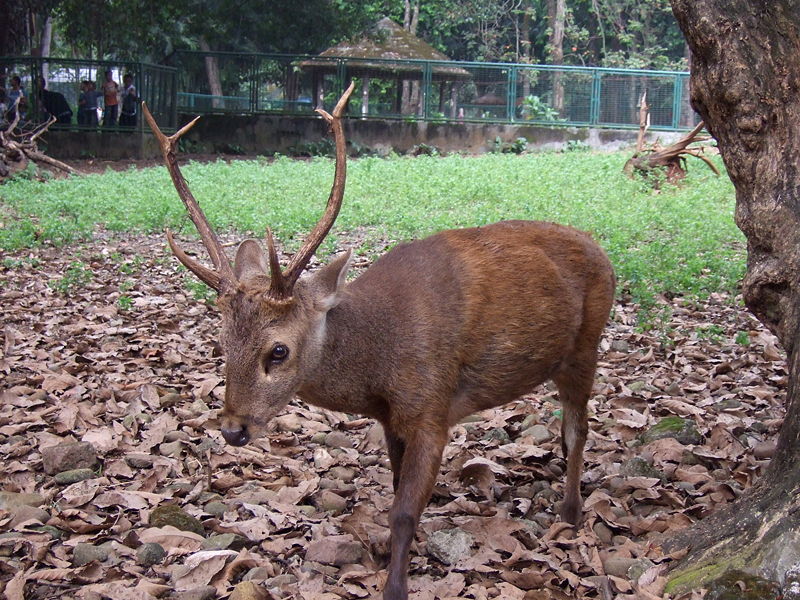
Bawean Island is the home of deer species, Axis kuhli. Bawean island hasplenty of fruit trees, mangosteen, salak, Dorian for local consumption. The shore of Bawean is rich of fish.

Bawean inhabitants are mostly Moslem, and non Moslem usually are immigrant. Bawean has onyx stone, and typical fruit called buah merah, that is different than buah merah from Papua. Its shape is like apple.

Candi (Temple) Dorok, Kediri, East Java, Indonesia

Candi Dorok was discovered by farmer accidentally when he was about to plant gnetum tree in his yard. The Archaeology office then excavated area and found a square plan of redbrick building. The upper temple is gone and only the body and base still left. Candi Dorok is located in Dorok village, Manggis, Puncu, Kediri Renegcy and it was made of red brick as other temples in East Java. As the temple was buried for quiet long time, and no renovation effort is excecuted and this temple is 3 meters beneath the surface.

The relief is damaged, and there is no statue found. According to the temple material, it is estimated to be established around the 1oth century.

Kwan Sing Bio, The Crab Monastery, The Biggest Chinese Temple / Monastery in South East Asia, Tuban, East Java, Indonesia

This temple is one of most visited temple is East Java. Not only Surabaya or Semarang people, but also Singaporean, Chinese and Malaysian visit this temple. This is the only temple in Indonesia that faces ocean.  It said that it was built so to show that this temple is strong and that people praying in this temple will get whatever they pray for. No wonder if people flock to this temple. And this temple is known as the biggest temple in south east asia and it is unique as it use crab decoration for its entrance, unlikt other temples that usually use dragon figure.

Kwan SIng Bio Temple is located in Tuban, and visited by Chinese for its sacred image. The temple was built on coast area for emergency and coincidence reason. According to its history, there was a temple in Tambakboyo, 30 Km west of Tuban city. One day, the temple officials moved Kwan Kong statue to Surabaya by ocean route. On Tuban area, the ship was sunk for hitting rock and other effort to draw the ship did not work. And it created an idea to establish a temple on littoral area.

The temple then built and kept evolving especially on the rear part. The architecture of Chinese can be seen the temple building. And the temple undertakes Chinese new year celebration, not only with barongsai but also Chinese Puppet Show, fireworks, kung fu and other performances.

For visitors, the temple provide free of charge lodging, meals for huge amount visitors.


Gua (Cave) Selomangleng: Endanger Historical Cave, Kediri, East Java, Indonesia

Selomangleng Cave is located in Sanggrahan Kidul village, Sanggrahan, Boyolangu, on steep slope of Jurang Sanggrahan. The temple complex is side by side to farm land, and divided into lower section and steep section. The the first mention section, there are two caves and on the later mantiones there is a temple.

Those three buildings were constructed on a gigantic rock. The first cave is located on a relatively flat surface, the result of the dredging of the monolith in the shape of 2 rectangles as the cave mouths.The first cave is decorated with relief and the other one is plain. The area of the monolith covers 26,5 m x 26 m. The cave chamber covers 360 cm x 175 cm, and 380 depth. The cave entrance faces west. Relief is engraved on the east and north wall panel. The decoration depicts Arjuna Wiwaha tale, when Indra orders his angels to seduce Arjuna that is meditating on Mount Indrakila. The angel goes down from heaven to earth.

The second cave is located on the southward of the first cave, and at the same monolith, only the position is higher. This cave faces south and it is plain, the size is 360 cm x 200 cm. Few meters on the ast of this cave, there is a higher monolith with foot engraving and square temple base of 490 cm x 475 cm. The base wall is decorated with Greek bar with square frame.

There is no written source to know more about this historical site. The relief on this site resemples to tat of Jalatunda Temple, a bathing place located at Trawas. AJ Barnet Kempers stated that the site was constructed and used in the end of 10th century. According to the carve-work, and the way the characters hairs depicted, Satyawati Suleiman stated that the cave was from the early period of Majapahit.

In Tulungagung, relief was carved on Arjunawiwaha tale, especially the episode of the angel seduction to Arjuna who is meditating.This reflects the close relationship with Kediri Kingdom. This relief to remind any meditation ritual they hold and the hope that the power of the tale will be reality.

Local legend said that the cave was the place of Dewi Kilisuci, King Airlangga’s Daughter from Kahuripan Kingdom. She was never menstruate, and she spent her days worshipping God until she moksa (disappears)

Di dalam goa yang memiliki tiga ruang utama dan dua ruang tambahan inilah Dewi Kilisuci yang dikenal sebagai perempuan kedi (tidak menstruasi), menghabiskan hari-harinya dengan memuja Sang Pencipta hingga ia muksa (hilang ditelan bumi).

The cave name, selomangleng derives from Javanese,  selo means stone or rock and mangleng means projecting or protruding.

The cave has small rock bedroom, on the left side there is a dark room and on the right side as well. And there is a hole that connects to other hole on the right side. There is relief on the cave about Dewi Kilisuci when she was proposed by Kelono Siwandono from Bantar Angin Kingdom.  There is also relief about Patih Buto Lohcoyo when he was patiently accompany Dewi Kilisuci. This Patih was pictured to have big body. Actually there are other reliefs but the tales have not been revealed as the reliefs are not clear and have been covered by incense smoke. If the incense smoke proceeded to cover the relief, soon the whole relief will be black and plain. The Cave is used by local people to start ritual or traditional performance until today.


Totok Kerot, Dwarapala Statue, East Java, Indonesia

At a glance, Totok Kerot statue looks like Dwarapala statue in Singosari. Only this statue is more damaged as few parts are missing especially the left arm. The statue doesnt carry club as Dwarapala, or maybe the Club part is missing, there is no explanation about this yet.

This statue is an inscription in King Sri Aji Lodaya period, from Pamenang Kingdom. It said that there was a princess came to Pamenang Kingdom, and this princes was from Blitar. She came to marry Joyoboyo, that was popular for his power. And unfortunately, Joyoboyo rejected her. They both then fought, but the princes could be defeated by Joyoboyo and she was cursed to be Dwarapala, or Totok Kerot.

When discovered, the statue was buried under the ground in 1981. There was a local legend about this statue. The Totok Kerot statue was moved to Kediri Alun-alun (city square), but seemed that the statue did not like this new place. Midnight, there were 7 cows and 2 elephants on the square, and they pulled Totok Kerot statue to Bulu Pasar, the original location of the statue. As the statue was so heavy, they only moved the statue several meters only and they were died.  In the morning, Totok Kerot found few meters from his location and the animals laid around it, and the statue was moved to its original location.

Goa (Cave) Istana Maharani, Lamongan, East Java, Indonesia

Istana Maharani cave is located 200 meters from Java Sea, in the complex of Tanjung Kodok or Wisata Bahari Lamongan. The location is a resting area for Walisongo pilgrimage tour. On the east of Maharani Cave, approximately 1.5 km, there is tomb of Sunan Sendang Duwur that is located at Gunung Amitunon, the cremation in Majapahit and Singosari Kingdom period.

The cave is 2500 sqm, and it takes less than half an hour to explore the cave by following stairs passage made of concrete. The lamps light the stalactite and stalagmites that have unique shapes, of throne, animals or flora. There are numerous name of those natural shape cluster.

Gos Istana Maharani was discovered accidentally by a stone labour, Sugeng, on August 6th 1992.  His handspike hit a wall where there is a big tunnel inside. People suggested names for this cave, and local government agreed Goa Istana Maharani as the name of the cave. This name was came out after a women dreamed about a beautiful woman with colorful dress and crown made of gold and diamond, with rose and dahlia motives. And when the woman woke up, there was a subtle whisper that the name of the queen in her dream was Maharani.