All posts by admin

Javanese Wedding Procession

In meeting the future bride/groom, there are chronology sequences;
1. Babat Alas means opening forest. In this sequence the parents of the future groom find out if the girl has yet a boyfriend or future husband or not. Or in javanese, this is called as nakokake (asking).
2. If the man does not know the woman yet, then he would be invited to go to see woman that is picked by the parents.
3. If the man agrees, the parents will propose the woman where the man parents hand in set of full clothes for woman, or in Javanese called as sandangan sapangadek
4. Before the wedding, the family of the groom give wedding gifts to the future bride. The gifts are crops, household items, livestock and sometimes money.
5. Seven days before the wedding (in the past it was 40 days,means the bride will be pingit means she may not go out of the house and may not meet the future husband. After the pingit period over, the woman will be showered and treated like in traditional spa.
6. One or two days before the wedding procession, the woman house is decorated nicely with tarub (tent).
7. Siraman Ceremony is a ritual to shower the bride with water and flower of rose, jasmine and ylang and proceed with ngerik ceremony. Ngerik ceremony is to remove hairs on forehead,neck, nape and on the cheek.
8. After Ngerik Ceremony, at night held Midodareni Night, where the groom come to the bride house and the groom should undergo Nyantri ceremony.
9. In the morning or afternoon, the wedding procession is held to officially wed the bride and groom.
10. After the procession, the panggih procession where bride and groom meet.
11. Five days after the wedding procession, Ngunduh Mantu ceremony is held. Ngunduh means taking and mantu means son in law. Usually in this phase, the wedding party is held.

Chronologically, Javanese wedding from the beginning to the last sequence is;

1. Siraman Ritual for the bride and groom (Shower Ritual with flower water)
2. Midodareni Ritual
3. Akad Nikah (Wedding Procession)
4. Panggih Procession (Bride and Groom Meeting)
5. Wedding Party
6. Post Wedding Ritual

Here are the deeper meaning of each ritual sequences:
1. Siraman Ritual for the bride and groom (Shower Ritual with flower water)
This ritual is held before the wedding procession that is undergone according the religion of the couple. The important things in Siraman Ritual are:
-Siraman Pengantin Putri (Siraman for Bride)
The bride wears grompol batik motives and doubled with 2 meters white fabric with hair loosened. The parents of the bride shower  her, and then followed by parent of the groom, and other family members that can be seen as good example for her. The make up artist also showers her afterwards and the the bride herself shower. It is recommended to use warm water, so the bride will not get cold.

– Siraman Ritual for The Groom
This ritual similar to the bride siraman only parents of the groom will shower him first.
After the ritual, the groom will be placed in a house not far from the bride house/room. As the bride and the groom may not live together yet. After siraman, the bride will wear Kerik costume, that is when she will have her forehead hair cut entirely.

2. Midodareni Night Ritual
In this ritual the bride wears plain costume and may not wear any jewelleries except wedding ring. At that night the groom comes to the bride house. For Yogyakarta style, the groom wears surjan, blangkon Yogyakarta, necklace, keris. For Surakarta style the groom wears beskap, necklace, and keris. But for simple, the groom can wear suit and tie but not bow tie. Round 19.00, the groom comes to the bride house to know the bride’s family and friends. Arriving at the bride house, the groom will be submitted to the bride’s parent. Groom will reside at house not far from the bride, and then meeting guests, but he may not bee too tired as there are still few sequences to go. The bride should reside in the wedding bedroom, and she could sleep after 24.00. Guests on Midodareni night usually are couples. On 22.00 to 24.00 the guests will be entertained with Javanese cuisines.

Here are equipments for Panggih ritual:

1. four sindur (shawl) worn by parents.
2. four meters white fabric and cut into two.
3. 2 sheets of mats to sit for bride when make-up process is ongoing.
4. 2 jar to shower the bride and groom.
5. 2 ivory coconut with  stalks
6. an egg of hen
7. various flowers
8. 1 basin and bailer to wash the feet of groom
9. 2 shawls in square shape.
10. Daham Klimah is a ritual when bride and groom feeding each other. For this ritual should be prepared yellow rice, chicken curry. And in Tanpa Kaya ritual should be prepared with coins, rice, peanut, green bean, soya bean, corn.

3. Wedding Procession
The procession held according to the couple religion. For moslem, this can be undertaken at Mosque or asking penghulu to come. After procession, the groom waits outside for the next ritual. In the procession the groom should not wear keris (should be removed from the groom first), and the batik or blangkon used is not animal motives. For moslem, christian or catholic, the religious procession should be preceded and then afterwards the custom tradition can be carried out.

4. Panggih Ritual
This ritual is preceded with Balangan when the bride and groom throwing each other betel leaves and then shake hands to symbolize introduction. Afterwards is Wiji Dadi ritual where the bride wash the feet of the groom. And then Sindur Binayang is ritual where the bride and groom walk behind the father of the bride while mother walks behind them.This symbolizes that father always give guidance to the children for happiness while mother push them and support them ‘tut wuri handayani’. Timbang (Pangkon) and Tanem is when the father of the bride let the bride and groom to sit his legs as symbol that he blesses them. Tukar Kalpika is exchange ring ritual to replace the ring from left ring finger to right ring finger and they do this to each other. This symbolizes husband and wife should love each other to be happy. Afterwards then kacar kucur ritual that represent husband works for wife and family.And Kembul Dhahar ‘sekul walimah’,when the bride and groom feed each other, symbolizes that the fortune is from God and happiness and sorrow should be born together. The Groom patiently waits for the bride to finish the meals, as usually a mother care about food and does not like to throw away food, this means that God always give fortune and the they should be thankful. Mertuwi Ritual is ritual of parents of the groom picked by the parents of bride parents to see the legalizing of the marriage. After that they all sit and then proceeded with sungkeman ritual where bride and groom should sungkem (kneel) in front of all parents. This is a message that the bride and groom should respect parents even after the marriage.

TERMS AND MEANING
Tarub is an emergency building built nearby the house where wedding will be held. Here are items should be prepared for tarub are;
-Pair of banana plant is a symbol of hope that the family will be a good leader for family and nations. Banana can grow anywhere that the couple is expected to easily adopt to their new environment to succeed.
-Black Sugar Cane (tebu wulung). Tebu derives from antebing kalbu means a strong will and wulung means rape = smooth. The couple is expected to think of everything rape not prematurely and have strong will or mulat sarira hangrasawani.
-2 set of young ivory coconut
This symbolizes that they should have strong will to reach their goal.
– Leaves of banyan tree, Maja, Koro, Andong, Reeed and Apa-apa. They symbolize that couple in the future will be like banyan tree to protect the environment, and that everything will be in good circumtances (aja ana sekoro-koro alangan sawiji apa)

Kraton Yogyakarta Royal Wedding October 18th 2011

The wedding procession of Yogyakarta royal wedding was held at Panepen Kraton Yogyakarta on October 18th 2011. The Bride is Princess Gusti Raden Ajeng Nur Astuti Wijareni, the youngest daughter of Sri Sultan Hemengkubuwono X. The groom,  Achmad Ubaidillah or Kanjeng Pangeran Haryo Yudanegoro looked handsome in white beskap with classical motives. The wedding date was picked carefully according to Javanese calculation based on birthday of the groom and bride.

The wedding procession was only attended by the groom and Sri Sultan, while the bride and the groom will meet on the  panggih procession after the wedding procession at Bangsal Kencono. Panggih is Javanese means ‘meet’.

Panggih Procession was accompanied by 3 Janavese rhymes, Gending Bingri played when the groom arrives, Gending Ladrang Pengantin, to accompany the panggih procession from balangan (throwing betel leaf to each other). wijik dadi (stepping/breaking egg) and washing husband feet procession. And Gending Boyong/ Gending Puspowarno to accompany kacar kucur, to symbolize the handover of livelihood. In the pangggih procession, guests.

The entire event started on 16 October till 19 October 2011. On the 16 October, the groom was received at the veranda of Ndalem Mangkunegaran to expect the royal family who will take him to royal coach, then led to Bangsal Kesatrian hall and resided at Gedhong Srikaton building. At the meantime, the bride underwent Plangkahan ritual at the western palace to get blessings from GRA Burabra Juwita, her still single older sister. This ritual was proceeded with ngabekten, asking blessing from the whole royal family.

The bride and groom looked amazing in dodotan costume. The wedding was attended by President SBY, foreign ambassadors, kings of  Indonesia regions.

Image : The Jakarta Post


Lombok International Airport starts operations

The West Nusa Tenggara  officially opened, on Saturday, Lombok International Airport in is ready to encourage tourism Lombok, an island next to Bali.

The new airport is located in Pujut district in Central Lombok regency, approximately 40 kilometers south of Mataram,  West Nusa Tenggara capital city.

The airport is managed by state airport operator PT Angkasa Pura I, and replaces the old Selaparang Airport, which had been the main portal for entering Lombok.

A Boeing 737-800 JR airplane operated by national flag carrier Garuda Indonesia was the first commercial aircraft to land at the new airport, carrying West Nusa Tenggara Governor Zainul Majdi and his entourage, as well as Transportation Ministry director general for air transport Harry Bhakti, from Soekarno-Hatta International Airport in Jakarta, Antara reported. (The Jakarta Post, October 1st 2011)

Candi (Temple) Prambanan or Candi Roro Jonggrang, Yogyakarta, Biggest & Most Beautiful Hindu Temple in Indonesia

Candi Prambanan is located 17 KM on the east of Jogja (Yogyakarta), notably in Prambanan village, Bokoharjo destrict. The location only 100 km from Yogya-Solo mainroad, and visible from the main road. Prambanan area is located on the elevation of 154 m above sea level, and partly is Sleman regency’s area, and partly are Klaten regency area.

Candi Prambanan is the largest Hindu temple in Indonesia. There is still not strong evidence who ordered to build the temple, or the period it was constructed, but allegedly this temple was established in the midst of the 9th century, as ordered by king from Sanjaya Dynasty, King Balitung Maha Sambu. That opinion is based on Syiwagrha inscription found nearby Prambanan and now preserved in National Museum in Jakarta. The inscriptions dates back 778 Saka or 856 AD written in Rakai Pikatan period.

The temple restoration took quiet long time, as it would never end. The discovery of biggest structure, Candi Syiwa, was reported by CA Lond in 1733. And excavation was finished in 1885, by clearing the bush and grasses, and stone blocks classifications. In 1902, the preservation effort was continued by van Erp by more concise ruins classification. In 1918, the restoration was held by Dinas Purbakala (Oudheidkundige Dienst) led by PJ Perquin, that the ruins of Candi Siva can be reconstructed. In 1926, a restoration committee led by De Haan proceeded Perquin work, and this committee Candi Siva is accomplished, and started to reconstruct Candi Apit. De Haan died in 1931, and replaced by VR van Romondt. In 1932, restoration of Candi Apit was completed. The restoration was ceased in 1942 when Japanese overtook Indonesia. In 1953, Siva Temple restoration and 2 Candi Apit were completed.

The Candi Prambanan is a rectangluar area, consists of outer courtyard, and 3 inner yard. The inner court yard comprises of 3 areas, Jaba (outer yard), Tengahan (middle yard) and Njeron (inner yard. The outer courtyard is an open are that is surrounded Jaba, a square area of 390 sqm, that was encircled by stone block fence, that now can be seen as ruins. Jaba is currently empty, and whether there was building or other decoration here is still unknown. In the middle of Jaba yard, located Tengahan (middle yard), a square area of 222 sqm. This middle yard is encircled by stone blocks fence that is damaged and only ruin left. This yard comprises of 4 terraces. The first terrace, the lowest one, has 68 candi kendil that line up encircling and separated into 4 lines by connecting passage between the yards doors. On the second terrace stand 60 temples, and the third terrace there are 52 temples, while on the fourth or the highest terrace, there are 44 temples. All of temples on the middle yard have same construction and size, with basic size is 6 sqm and 14 m high. However most of the temples on the middle yard are now only ruins left. The inner yard is the highest area, and the most sacred area, with base of 110 sqm. and height is 1.5 m from middle yard terrace. This yard is encircled by stone fence, and four sides are completed with paduraksa gate. Currently only the south side gate that remains intact. In front of every gate, there are 2 temples, with square base of 1.5 sqm and 4 meters high. On this yard, there are 2 lines of temples north to south. The west line consists of 3 temples facing east. The north most temple is Candi Wisnu, middle is Candi Siva and at the south is Candi Brahma. The west line comprises of 3 temples facing west, that are called as candi wahana. Wahana means transport or vehicle, as those temples were names according to animal serving as gods transportation modes that are located in fromt of them. Temple located in front of Candi Wisnu is Candi Garuda, facing Candi Siva is Candi Nandi and facing Candi Brahma is Candi Angsa. The six temple are created a passage way. Candi Wisnu, Brahma, Angsa and Nandi have same construction and size, with square base of 15 sqm and 25 m high. On each end of the passage way located small vis-a-vis temple, called Candi Apit.

Siva Temple

When Siva temple found, it was in a very bad and damaged condition. The restoration took long reriod from 1918 to 1953. This temple is called as Siva temple as there is Siva statue inside the temple. This temple also called Roro Jonggrang temple, as in one of the chamber located Durga Mahisasuramardini statue, that is called as Rara Jonggarang statue. The temple body stands on a 2.5 m platform. Candi Siva is located on the middle of west line and the biggest one. The base id square of 44 sqm and height is 47 meters.

Along the temple foot wall is decorated with carving of 2 ornaments intermittently engraved. Those ornaments are lion figure standing between 2 kalpataru tree. This ornaments are depicted on the foot of Siva temple and other 5 temples. On the north and south  side of temple foot wall of Candi Siva, the lion ornament is flanked by a panels of pair of animals shading under a kalpataru tree growing from vase. Various of animals depicted here are monkey, peacock, deer, rabbit, goat and dog. On every tree perch 2 birds. On the other side of foot wall of Siva or other big temples, the animal panels are replaced with panel with kinara-kinari, pair of birds with human head, that are shading under kalpataru tree.

The stair to the platform surface located on the east and completed with railing decorated with tendrils and animal. The base of the railing is decorated with dragon head with open-wide mouth with a god figure inside the mouth. On the left and right side of the stair, there are candi kendil with pointed roof and carved with Siva and each side of the temple body. In the stair top located paduraksa gate towards the temple passage. the gate is decorated with Kalamakara carved beautifully. Behind the gate, stand pair of temples completed ith niches of Mahkala and Nandiswara, the gate guards.

On the platform sufrace, there is 1 m wide passage encircling the temple body. The passage is completed with fence, that it looks like a roofless aisle. This aisle is winding on angles, and separated the temple wall into 6. Along the temple wall decorated with carving or Lokapala , gods of wind directions, Bayu, Indra, Agni and Yama. Along the wall of fence, carved Ramayana epic that is depicted clockwise, starting when Visnu asked by gods to go down on earth to solve matter about  Rahwana, and ended on the completion of bridge on the ocean from Alengka. The story is proceeded at the wall of Candi Brahma fence.

Above the fence is decorated with ratna, and under ratna, on the outer side of the fence is decorated with small niches with Kalamakara ornament. Inside the niche there are 2 carving motives intermittently, namely 2 human standing and holding hanhs and 3 human playing various instruments.

Entrances to the temple rooms located on a higher terrace. To reach to the higher terrace, there is stair in front of entrance. Inside the temple, constructed 4 room encircling the main chamber situating in the center. The entrance to the main chamber is plain without statue or decorations. The entrance in on the same line of entrance to the east room. This main chamber is called as Siva chamber as there is a statue of Siva Mahadewa, Siva standing on a lotus with one hand raised in front of chest while other hand poses horizontally before his abdomen. The statue stands on a base (umpak) with 60 meters high, in yoni shape with water drainage channel along the surface edge. It said that this statue presented King Balitung from Hindu Mataram Kingdom (898-910) that was deemed as Siva.

There is no entrance connecting Siva Chamber to 3 other rooms. The north, west and south rooms have private entrance located inf ront of the stairs to terrace. Inside in north room, stand Durga Mahisasuramardini statue, she is the goddes of death, that represented the queen of King Balitung. Durga has 8 hands standing on Nandi bull faces Candi Visnu. one of her right hand is put on a club, white other hands holding arrow, sword and spiky disk, respectively. Her left hand holds Asura head, dwarf devil standing on a mahisa (bull), while other hands hold arc, shield and flower respectively. Local people call this statue as Roro Jonggrang statue, as they believe that it is the manifestation of Roro Jonggrang that was cursed to be stone by Bandung Bondowoso. Inside the west room located Ganesha statue in cross-legged sitting position on padmasana (lotus throne), with left and right foot meet each other. Both hands put on knee with palm facing up, while the trunk lops on its left arm. Ganesha represented the royal prince of King Balitung, and the sash on its shoulder shows that he was also a warlord.

Inside the south room there is Agastya or Siva Mahaguru. This statue figure is fat, and bearded, he stands facing Cabdi Brahma on the south and his hand carries rosary and jug.  Behind him, there is a fly repellent tool on the left and trisula on the right. Siva Mahaguru represented a priest, the adviser of the kingdom.

Visnu Tempe

Visnu temple is located on the north of Siva Temple. The temple body stands on a platform that created a balusters passage. The stairs to the platform surface is located on the wast, and along the temple wall, lining up panels with Lokapala carvings. Along the baluster wall is decorated with a line of panels with Krisnayana reliefs. Krisnayana tells about Krisna life from his birth to the period when he reigns in Dwaraka. On the balusters wall, there are ratna decaration, and under ratna, on the outer side of the baluster, there are niches with Kalamakara ornament. Wisnu as priest sitting with various positions are depicted in the niches.

Candi Wisnu has i chamber with one entrance facing east. Inside the chamber, there is Wisnu statue standing on a platform (umpak) in the shape of yoni. Wisnu figure has 4 hands with right hand holds Cakra (Wisnu weapon) while the left hand carries clam. The right hand holds club and the other left hand carries lotus.

Candi Brahma

Candi Brahma is situated on the south of Candi Siva. The temple body stands on platform creating balustrade passage. Along the wall of the temple wall is also decorated with Lokapala carvings. Along the inside wall of the balustrade is decorated with line of panels with Ramayana story, sequel of that on Siva Temple. The Ramayana depicted here started with Rama that is helped by her brother Laksmana, and monkey troops to fight against Rahwana, and then after Sinta could be retrieved from Rahwana, Rama doubts her purity and loyalty, and then she wanders in jungle. Sinta gives birth to her son in jungle under the protection of an ascetic. On the wall of the balustrade, is decorated with ratna ornaments. Under those ornaments there are small niches decorater with Kalamakara and the inside of the niches are engraved with Brahma as priest sitting on various hand position.

Candi Brahma only has one chamber with one entrance facing east. Inside the chamber there is Brahma statue in standing position and put on yoni umpak just like the other temples. The Brahma figure is a god with four faces, heading different directions, and 2 pair of arms. On the forehead facing forward there is a third eye called as urna. This statue is beautiful, only it has been damaged. The wall of Brahma chamber is plain and no decorations. On every side of the wall there is a protruding stone to place oil lamp.

Candi Wahana

Candi Nandi has one entrance facing west, to Siva temple. Nandi is a sacred bull the ride of Siva. This temple has same shape to Candi Angsa and Candi Garuda, only it is a bit bigger and taller. Temple body stands on 2 meters platform, just like Candi Siva and on the wall of the foot temple is engraved with two motives carved intermittently. The motives are lion standing between two kalpataru trees and a pair of animals shading under kalpataru tree. On the tree perch two birds. Those motives also found on other candi wahana. Candi Nandi has one room. The stair and entrance to the room is located on the west. Inside the room stands Nandi statue, Siva ride in lying position facing west. Inside the room also located Surya statue (god of sun) standing on a 7 horses-carriage   and Candra (god of moon), standing on 10 horses-carriage. The room wall is plain and there are protruding stone on every side of  wall to place oil lamp. The passage wall encircled the temple also plain,no decorations.

Candi Garuda is located on the north of Candi Nandi, face to face to Candi Wisnu. Garuda is bird of Wisnu ride. Inside the temple there is no Garuda statue, though it is named as Candi Garuda. On the room floor, there is Siva statue in smaller size that in Siva Temple. This statue was discovered buried under the temple and actually it was not the part of the temple.

Candi Angsa is located on the south of Candi Nandi, vis-a-vis to Candi Brahma. Angsa is the ride of Brahma. The size, shape, and decoration on the temple foot is same to that of Candi Garuda. The room inside the temple is empty. The temple wall is plain, only stone to put oil lamp on each side of the room wall.

CANDI APIT

Candi Apit is pair of temples vis-a-vis. The location of each temple is on the south and north end of the aisle between the lines of big temples. Both templea is square with 6 sqm and height 16 m. Temple body stands on 2.5 m platform. There is no walkways on the temple foot surface. Each temple has a stair to the only chamber inside.

CANDI PENJAGA (GUARD TEMPLE) is smaller temple with base of 1.25 m2. Four of them located on the corner of the yard, while the others are located nearby the entrance gate at the upper yard.

Rara Jonggrang Legend

Loong, long time ago there was two neighboring kingdoms, Pengging, ruled by King Pengging and Prambanan ruled by Prabu Boko. Prau Boko had a giant figure and he was very powerful and known as a heartless king, and he held ceremonial ritual regularly with human sacrifices, but he had a very beautiful daughter, Roro Jonggrang. King Pengging was send as his people were disturbed by troops of Prambanan Kingdom. King Pengging wanted to stop that but Prambanan Kingdom was too powerful. He, then asked his son Bandungto meditate to get power from god. God gave him a powerful goblin that always obeyed him. From that moment on, he was called as Bandung Bondowoso. Later Bandung Bondowoso departed to Prambanan Kingdom and he could killed Prabu Boko. Bandung fell in love with Roro Jonggrang and proposed her. But Roro Jonggrang did not want to marry the killer of her father, she could not reject him honestly thoughn so she said she would marry him with a condition, he should make 1000 temples in one night. Banding Bondowoso agreed and after the sun sets, he went to a flat area not far from Prambanan. He meditated and called his goblin, Bondowoso to build the 1000 temples for Roro Jonggrang. Bondowoso ask help from other goblin to finish the work. Roro Jonggrang was worried when she found out that Bandung could make 999 temples. So she went to the nearby village as woke up girls there to pound paddy with wooden mortar. The sound of mortar made cocks crowning. Goblins thought that it was dawn already, so they left the work. Bandung was angry that Roro Jonggrang cheated. He cursed her to be a statue, that now found at the temple complex. He also cursed that girls in Prambanan will be spinster.

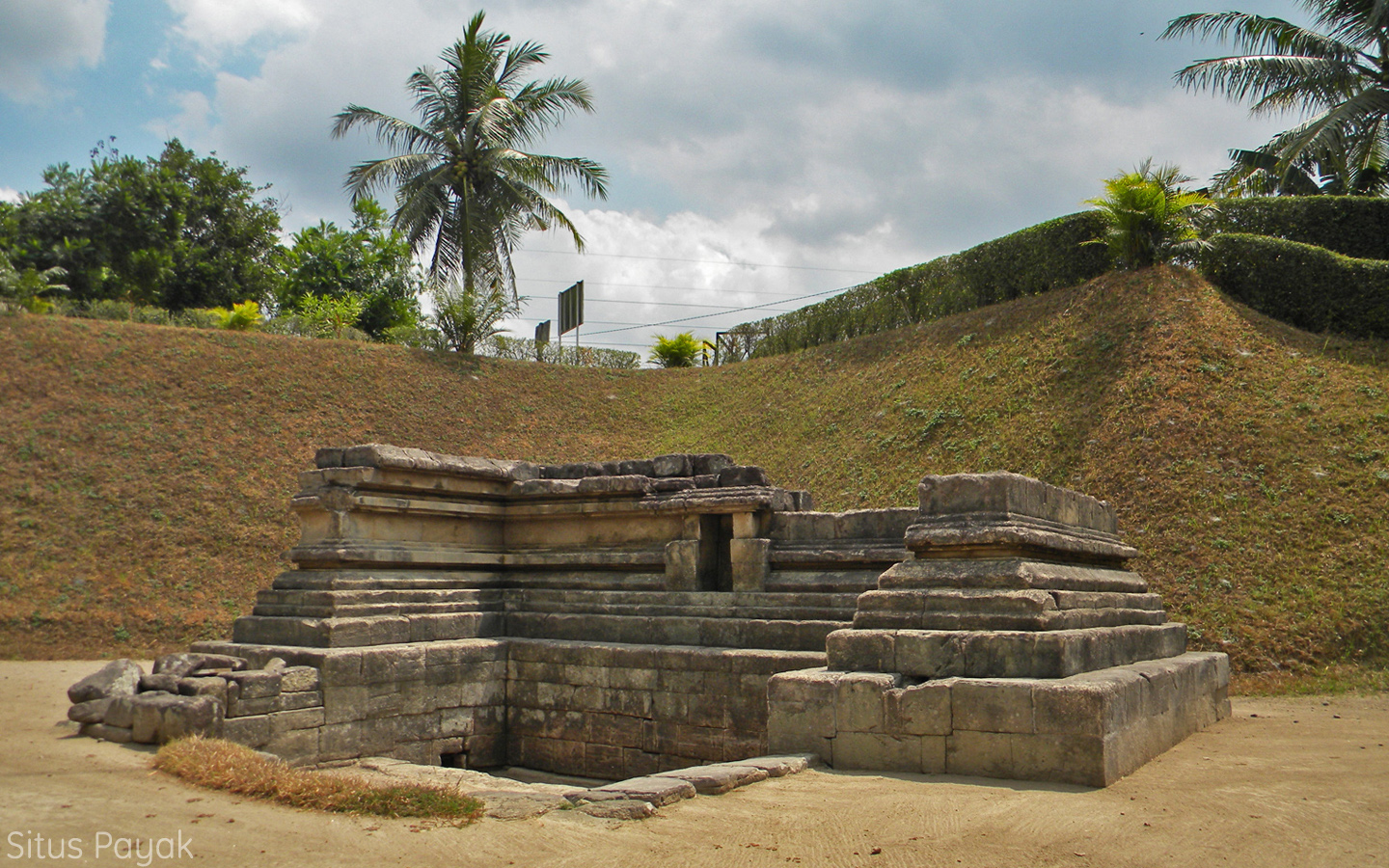
Payak Site, White Stone Block Bathing Place, Bantul, Yogyakarta, Indonesia

Payak site is one of Yogyakarta classic bathing place. The site is located few kilometers on the east of Candi Mantup, notably at Payak, Baturetno, Banguntapan, Bantul, Yogyakarta, Indonesia.  The building structure left is only white blocks pool 312 cm x 124 cm, completed with U shape wall and 25 cm x 25 cm waterways  located on the southwest of the pool. The pool bottom in equipped with water disposal.

On the northwest, there is a niche for Siva made of limestone. In 1980-1983, discovered a 17 holes container that symbolizes Wastupurusamandala, a diagram utilized as metaphysics design and building lay out. The container was made of silver and gold.

This bathing place seems to have an important role in religious ceremony in classic period as water was one of  important elements in ceremony held in sacred temples. There were also earthenware fragments that mostly in the shape of jug. This building is estimeted to be constructed date back at the 9th century.


Situs (Site) Bugisan, 6 Buddha Statues, Sleman, Jogja, Indonesia

Bugisan site is located at Bugisan village, Purwomartani, Kalasan, Sleman Regency, Jogja, Indonesia. Bugisan is estimated to be ruin of Buddha temple, as there were found 6 Buddha statues on the location. Among all the statues, only one that still has head, though with not intact condition.

In the site, also discovered temples parts, such as makara, the decoration in front of entrance, in shape of fish with elephant head, also decorations of outer temple building in shape of pointed triangle. Those components were scattered on few spots nearby the Buddhs statues.

Candi (Temple) Abang, Red Brick Ruins, Sleman, Yogya, Indonesia

It is hard to imagine the original architecture of this temple, as the whole part of the temple is now overgrown with grasses and it looks as just another stone blocks. This temple has square size, 36 meters x 34 meters, but the height is still not predicted yet. The center part of the temple is a well and there was a stair made of limestone. Few andesit blocks found around temple area  but the function has not been found yet. Approximately, the temple was built in the 9th and 10th century. in Old Mataram period. Continue reading Candi (Temple) Abang, Red Brick Ruins, Sleman, Yogya, Indonesia
Gupala Statue (Arca Gupala), Yogyakarta, Indonesia

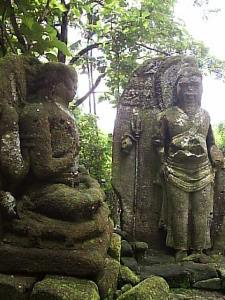
Arca Gupolo is a cluster of seven statues that scatered. Five of the statue are headless, even few of them are badly damaged that the real figure can not be seen and look like they are just another stone, not historical statues. The biggest statue is 2 meters high, statue of Agastya with decoration that has been fading, but floral motives can still be seen. And trisula relief can be seen clearly.

The second statue is agastya in sitting position. This statue is big only it has lost many details. The motives and relief are completely gone, even the face could not be recognized. This statue is located in front of the main statue.

Other five statues are smaller, and their condition is worse. All are headless, even few only left the lower bodies. Those statues are scattered two main statues that are in sitting position.

There is a spring located nearby the statues site that is used by local people. The surrounding of the site is very quiet, shade and trees grow lushly. The passage to the location is white rocky that is slippery in few parts.

This site is administratively located in Sambirejo Village, Prambanan, Yogyakarta, Indonesia not far from Candi Ijo and Candi Barong.

Arca Gupolo name derives from Arca means statue and Gupolo is how common people call Agastya. Local people has legend about Gupolo. Gupolo was the prime minister (patih) of  King Ratu Boko. Patih Gupolo pushed and buried Bandung Bondowoso to Jalatunda Well, as he killed King Ratu Boko. But as Bandung Bondowoso was very powerful, he could get out of the ditch.

Pagoda Avalokiteswara, Semarang, Central Java, Indonesia

This pagoda was erected in 2005, it has 7 storeys. This pagoda is dominated with statue of Kwan Im goddess that it is also called as Kwan Im Pagoda.

This pagoda is located in Semarang city and known as the highest pagoda in Indonesia. From the pagoda, visitors can see nice view, beside enjoying the Chinese architecture of the pagoda. As the large population of Indonesian Chinese in Semarang, the community built numerous religious buildings in town, such as Sam Po Kong Temple and Avalokitesvara Pagoda.

The pagoda building is 50 meters high from the ground level on  a land covering 2.25 hectares, one of the biggest in South East Asia and the highest in Indonesia. This magnificent building stands out, especially at night when it is decorated with lights. This pagoda has been the Buddhism education center. Avalokitesvara was erected to honor Dewi Kwan Im, known as the most respected and the merciful goddess by Chinese. Other name of this pagoda is Metakaruna, derives from meta means love and karuna means kindness, so Metakaruna means loving kindness. There is big Kwan Im statue in front of the plants, this statue faces Semarang city as symbol that she showers love to Semarang dweller.

The first floor of the pagoda which has 3 different Kwan Im statuary. Kwan Im figure with lotus in her hand is for visitors who wish for mates can pray before this statue. For couples who want to have children can pray at the other statue of she carries babies. And the third statue is for pilgrims who wants to have long life.

The decoration and architecture is typical of Chinese design . The main structure is octagon, dragon decorations dominate the building from lamps, roof, fountain, pillars, stairs. Other animals also can be seen here such as phoenix statuary and lion-like animals. Inside the main room, there is a huge Buddha statue, and few statuary god and goddesses of Chinese encircle the room.

This pagoda carries out several annual  ceremonies, such as Maghapuja (March), where thousand of Monks pray to Buddha, Vesak (May), the Buddha birthday, Ashada (July) to commemorate the day when Buddha taught 5 disciplines and Khatina (October) when monks meditate and study Buddhist in the temple. Chinese festivities are also held here, such as birthday of goddess of mercy, when she acheived enlightment and went to nirvana, celebrated every 19th of the 2nd, 6th and 9th month.

There is a local legend about the pagoda built here. Long, long time ago, the founder of Semarang meditated on a sacred hill. In 1957, a Buddhist monk from Ambarawa, Joko Suprapto meditated at the same site. In his meditation, he got vision that a shrine should be constructed on a hill. In 1965, then a small vihara was built. Later in 2005, built bigger vihara to accommodate Buddhist of different sects in Indonesia, Pagoda Avalokitesvara.