
 Bledug Kuwu is a mud volcano site attraction located in Kuwu village, Kradenan, Grobogan, Central Java. This location is 28 km from Purwodadi, and one of tourist attractions in the vicinity of Mrapen eternal flame and Kedungombo dam. The mud is popping up constantly, with 2 to 3 minutes tempo.
If in USA there is a Salt lake derived from shallowed sea and then shifted to spacious land, and now used as the fastest cars testing. Bledug Kuwu is a natural miracle. Bledug name derives from the explosion sound or bledug in Javanese, that is heard periodically from distance and smolders smoke, gas and salt. Bledug Kuwu was a sea bottom, currently is 53 meters asl, and 53 Hectares with minimum temperature 31 deg Celsius .
Bledug Kuwu can be rached from Semarang via Purwodadi. Along the trip, beautiful scenery can be seen on left and right side of the road, overlay of green rice paddy, and blue sky. When arriving at Bledug Kuwu, the green scenery will change to barren, hot and infertile place. Local people employ Bledug Kuwu for salt, that its salt is popular to Keraton Surakarta. In the proximity, there are tiny hills that the top expel yellow mud.
According to Dr AJ Panekoek, the region is an alluvial plain that expels vapor, gas and salt water. Alluvial plain is a relatively flat land-form created by the deposition of sediment over a long period of time. The sound from the mud is because of the break out of gray or dark gray mud, but if it is mixed with water will yield white mud. If the water is precipitated will yield limestone from ocean and then shifted to land. The erosion of limestone mountain surely will have limestone soil sediment.
Bledhug Kuwu has legend that became the background of this phenomenon. Since the Seventh Century, Grobogan was part of Medang Kamolan Kingdom that was reigned by Dewata Cengkar, that was a cannibal. People were afraid of him, as they did not want to be the king’s meal. No one can defeat the King as he was very powerful.
Later, Ajisaka, a wanderer, arrived in Medang Kamolan, and he was very concern about the people suffer. Ajisaka challenged Dewata Cengkar to fight one on one in front of thousand of people that expect Ajisaka to win. King Dewata Cengkar laughed out loud and accepted the challenge. The king said that if Ajisaka win, he could have half of the kingdom, but if he lose, he would be the meal of him. Ajisaka agreed and he asked the king that if he lose he asked the king to buried his bones in a soil as long as his turban length. The king didnt know that Ajisaka’s turban has power. Ajisaka took of his turban and spread on the ground, Miraculously the turban gut wider, and Dewata Cengkar should avoid the growing turban until he fell to the southern sea. He was not dead, but shift into white crocodile. Ajisaka then reigned as the King of Medang Kamolan.
When Ajisaha reigned, a dragon, named as Jaka Linglung, appeared and said that he was the son of Ajisaka. But Ajisaka rejected him as son and tried to get rid of the dragon with manner. Ajisaka said that he would take him as son if he could kill the white crocodile, the manifestation of Dewata Cengkar living in the southern sea. Jaka Linglung accepted that condition, and asked Jaka Linglung to go to the southern sea via under the ground, not land line as this would disturb people.
Jaka Linglung could kill Dewata Cengkar, and as he departed throung underground, he returned through the ground too. As the evidence that he had arrived at southern sea, and kill Dewata Cengkar, he brought grass of Cynodon dactylon, and salt water. Several times he tried to come up to surface as he thought he arrived at Medang Kamolan. First he came up at Ngembak village (Purwodadi), then at Jono Village, Grabagan, Crewek and last at Kuwu. At Kuwu, he rested, and the place where he came up is believed to be the legend of the appearance of Bledug Kuwu.
 Tanggulangin leather handicraft was initiated in 1939 when few craftsmen made bag and suitcase. In 1976, a cooperation was established, Koperasi Industri Tas dan Koper (Intako), with 27 members. The capital was originated from member savings. Later, the member grew until 354. But after the mud volcano phenomenon, many craftsmen closed the activities, and few were surviving by making as order. The media exposed mud volcano, and make people think that Tanggulangin was part of area flooded by mud, that made the visitors to Tanggulangin decrease severely. Geographically, Tanggulangi is approximately 5 kilometers from the source of mud volcano.
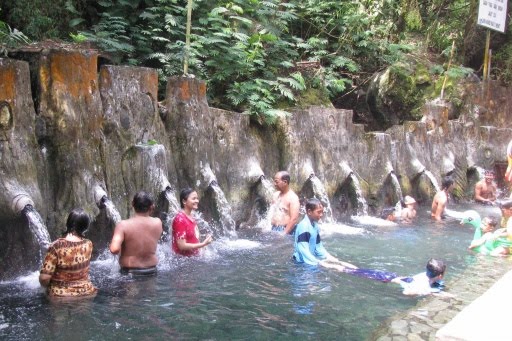 Once upon a time, Guci Spring was water given by Wali Songo (Nine Saints) to representatives that propagate Islam over western part of Central Java, notable around Tegal. The water was put in a guci (pot), and this water had virtue or blessings, so local people call the location of the water as Guci. As the water was not much and only limited, on Jum’st Kliwon (Friday in Javanese Calendar), one of the saint stick his cane, and with God favor, flew hot water without sulfur content. Until today, every Friday Kliwon, people flock to the spring to bath to get blessed.
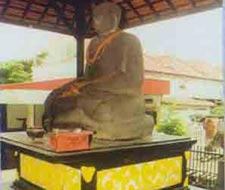 According to legend, this statue was made date back 1211 Saka or 1298 at Wurarare (Lemahtulis), the residence of Mpu Bharadah or at Kedungwulan village nearby Nganjuk. This statue was made to honor Kertanegara, son of Wisnu wardhana, the king of Singosari in that period. King Kertanegara was known for his wisdom, knowledge in law and his religiosity as Buddhist and his goal to unify nusantara.
 Ranu Grati is a lake located in Pasuruan regency, administratively situated in 3 villages; Sumberdawesari, Ranuklindungan, and Gratitunon village. The total inhabitant in the villages are approximately 19.000 people. The lake is not far from the northern coast road. Local people employ the lake for fishery, where people set karamba to catch fish.
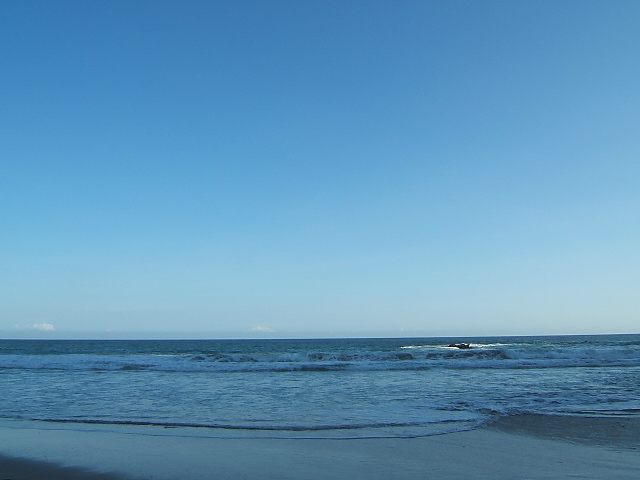 Modangan Beach is located at Kalitekuk village, Sumberoto, Donomulyo, Malang. Located 48 hm south of Malang. Geographically, Donomulyo region is located on mountain, valley, hills and southern sea coast. On the northern border is Kalipare District, while the east is Pagak disctict and west is Wates district of Blitar regency. It is not easy to reach this beach. It takes 2 hours through bumpy track. The beach is unique as it has layered andesit that geologically id frozen lava from volcano eruption. It has white sand, litter-free, and there are black rocks all over the beach.
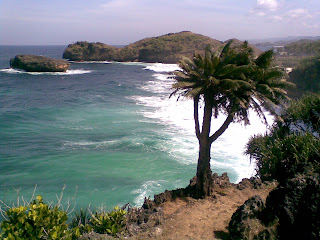 Srau Beach is located at Candi Village, Pringkulu, Pacitan, East java, approximately 25 km west of Pacitan City. To get to the beach, visitors can get public transportation or private coach.