
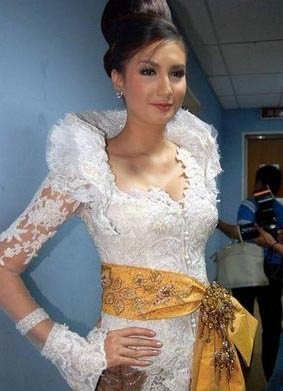
 Kebaya has hostory that flows as time goes by, and adapting to the modern time and has long history since 15 century, in Majapahit period. And the early designed was influenced by Islam. Before the advent of Islam, there is an inscription date back 9th century mentions term of kulambi (in Javanese=klambi, or cloth) and sarwul (Sruwal). However that clothes mentioned are estimated did not cover body well. The open shape of front part of cloth, was then influenced by Islam and change this into more covered design.
 Kebaya according to Hobson-Jobson dictionary is written to derive from Arabic, kaba means cloth but was introduced by Portuguese language. Batik expert, Rens Heringa in his work “Batik Pasisir as Mestizo Costume” (dalam Fabric of Enchantment, Batik from the North Coast of Java, 1996) shows the evolution of kebaya and and the origin word of kebaya. Estimated that kebaya was related to cambay that refers to cotton with floral motives imported from Cambay Port in India.
In Majapahit period, there were many nations meet for trading from China, India, Portugese, Arab and later Dutch. They influenced in the development of kebaya.
In history, kebaya was blouse that was first worn by Indonesian women, especially Javanese with jarik. But in 19th century, Kebaya design was also populer for Dutch women as it was suitable for tropical climate. Chinese descendant popularized kebaya encim during colonial period. Kebaya then evolved as feminism symbol, and now become national costume with various modern designs.
European descendants usually wore cotton kebaya with lace accent on its edge. And Chinese wore kebaya with shorter design and more simple with colorful decoration, or known as kebaya encim.
Kebaya design changed over time and it was ever forgotten. Moreover in Japanese occupation when creativity and productivity was limited and Japanese put pressure to the lowest level. In Japanese occupation, textile and its ancillary equipment routes was broken up, that lots of factory or production house closed and only few could survive.
Women that fought for independence still wore kebaya kartini and kebaya encim, and they re-popularized kebaya though it has western/modern outfit competitors. Western clothes were deemed to represent women independence out of kebaya, symbol of past that imprisoned women in twisted corset and long cloth.
After Indonesia reformation in 1998, Kebaya become new trend and flourish in woman fashion. If usually kebaya was made of silk, cotton ot velvet, later it is made of chiffon, shantung, lace, or even other textiles and later enhanced by embroidery, lace, gyre and pleated. Aplications also applied in kebaya design with ornaments of sequin, crystal, or stones. Now kebaya is not designed and worn with long fabric, but with jeans, shortng dress, or even hot pants. New kebaya creations can be seen from its pattern, silhouette, cutting or material.
 Gunung Srawet is located at Gunungsari, Kebondalem, Bangorejo covers 200 hectares on 500 meters elevation. This place is accessible from Jajag, only 20 km southward. It has very beautiful view and mild weather. Climbing Gunung Srawet can be a challenging for visitors.
 Pulau Tabugan is located in Bali Strait and separated Java to Bali ISland. Pulai Tabuhan is administratively located in Bangsring village, Wongsorejo, Banyuwangi. The only transportation to get there is fishermen boat, and it takes only 4o minutes from Kampe beach. The boat trip is very chalengging through big waves and rising adrenalin.
 Grajagan beach is located 52 km southward of Banyuwangi city, East Java, Indonesia. The position is very strategic that this beach is the gate to Plengkung or G Land beach. There are human made caves located on high place where we can see all the beach area.
 Plengkung beach or G land is known for The Seven Giant Waves Wonder situated at Alas Purwo National park, Banyuwangi, East Java, Indonesia. G derives from Grajagan, Green and Great. Grajagan the closest point to this beach, Green for its lush green surrounding and Great for its waves. The local name is Plengkung
 In front of Malang Mayor city hall, there is a round big garden where Tugu Monument, landmark of Malang stands. This garden is rich of beautiful and colorful flowers. It was Dutch that built the city of Malang with various city plans. This monument is in Bouwplan II that was included in city expansion or Gouverneur-Generaal buurt known as Alun-alun Bunder and completed with fountain and pool in the middle of it. Monument Tugu garden was former garden of Governor of East Indies Jan Pietersen Zoen Coen that is surrounded by beautiful garden with lotus. There are old trembesi trees grow here.
 One of the uniqueness of Papuma beach is octopus that live in superficial depth among reef. This mollusk is from Cephalopoda and Octopoda ordo and coral reef. Octopus has 8 arms not tentacles, with rounds suckers and cavity on its arms to move and to catch prey. Octopus arms is a hydro-state muscular that almost consists of muscle without bones and skull.
 Tirtosari waterfal is located nearby Sarangan lake, in Magetan, East Java, Indonesia. Visiting Sarangan lake will not be complete without visiting the watefall. The waterfall is only 2.5 km from Sarangan.
 Ider Bumi ritual is held by all member of Kemiren Village, from children to adults. And this has been custome since 1840. The involve ment of children enlivens the ritual, but indirectly children involved only in offering procession.