 In the special territory of Yogyakarta, there is a very traditional event Sekaten or also known as Pasar Malam Perayaan Sekaten, Sekaten Celebration Night Market, as before Sekaten, one month night market is held. This tradition is held since Demak Kingdom in the 16th , century annually every Maulud, the 3rd month in Javanese calendar, and it takes place on north square of Kraton Ngayogyakarta Hadiningrat.
There are several versions about Sekaten term derives from. The first version is that Sekaten derives from sekati means name of two keraton heritage, gamelan instrument Kanjeng Kyai Sekati that is played in series of birthday of prophet Mohammad. Other opinion is that Sekaten derives from suka and ati (means happy) as people celebrate Maulud celebration by thanking God and happy for the night market event on alun-alun utara. Sekaten also believed to derive from syahadataini, two testimony of faith in Islam, confessing there is no god but Allah and that Muhammad is the messenger of Allah.
 Sekaten is considered as mix of Islam propagation and art. In the begining, Islam in Java was spread by Sunan Kalijaga. He used Javanese gamelan to attract Javanese to come and enjoy gamelan instrument, Kanjeng Kyai Sekati. In the middle of the performance, he gave preaching intermezzo from the Koran and Islam knowledge. People then asked to make testimony of faith if they wanted to be moslem. Among Yogyakarta society and the vicinity, by become participant in celebrating the birthday of prophet Muhammad saas, they do good deed, and will be forever young. As the condition, they should chew betel leave in Yogyakarta Great Mosque yard,e specially on the first day of Sekaten celebration. Therefore, during the celebration, there are many betel leave sellers, rice with coconut with its side dishes at Kemandungan yard, Alun-alun utara, or in front of Yogyakarta Great Mosque. For farmers, it is their opportunity to pray for good harvets, and for this they buy whip and bring it home. Before the spiritual held, there are 2 preparations, physical and spiritual preparation. Physical preparation is equipment for sekaten, such as Gamelan Sekaten, Gendhing Sekaten, some coins, some Michelia alba, Sekaten outfit, text of prophet Muhammad, and other equipment.
 Sekaten Gamelan is the heritage of Kraton, Kanjeng Kyai Sekati that consists of Kanjeng Kyai Nogowilogo and Kanjeng Kyau Guntur Madu. Sekaten gamelan was made by Sunan Giri, who was an expert in karawitan, known as first pelog gamelan ever made. The paddles of gamelan were made of bull horn and to make good quality of sound, the paddle should be lifted as high as forehead before hit to gamelan. Gendhing Sekaten is series of music and song, Rambu pathet five, Rangkung pathet five, Lunggadhung pathet five, Atur-atur pathet nem, Andong-andong pathet five, Pendheng pathet five, Jaumi pathet five, Glitung pathet six, Dhindang Sabinah pathet six, Muru Putih, Prang aring pathet six and Srudeng gosong.
After Isya (night prayer), round 8 pm, abdi dalem in charge in bangsal give report to Sri Sultan that the ceremony is ready to start. After Sri Sultan order, Sekaten ceremony begins and Kanjeng Kyai Sekati gamelan is played. The first played is Kanjeng Kyai Guntur Madu with pathet gangsal, dhawah gendhing rambu. And then followed by Kanjeng Kyai Nogowilogo with gendhing racikan pathet gangsal dhawah gendhing Rambu. Both instrument played alternately. In the middle of the music, Sri Sultan comes closer and gamelan music is more mellow, until Sri Sultan leaves the room. Previously, Sri Sultan or his representative sprinkles udhik-idhik in front of Danapertapa gate, Sri Menganti room and Trajumas Room. On 24.00 shart, sekaten gamelan is moved to Yogyakarta Great Mosque and guarded by Mantrijero and Ketanggung troop. Kanjeng Kyai Guntur Madu is placed at the south of mosque gate while Kanjeng Kyai Nogowilogi is placed on the north of the gate. Gamelan sekaten is palyed over and over night and day for 6 days, except on Friday night until Friday prayer.
Grebeg Muludan
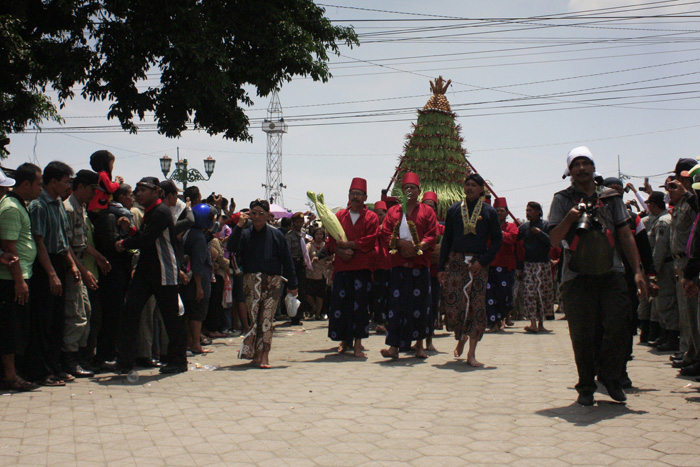
 The peak of Sekaten celebration is Grebeg Muludan held every 12 Maulud, on prophet Muhammad birthday, from 8 am. A gunungan guarded by 10 sections of troops; Wirobrojo, Daeng, Patangpuluh, Jogokaryo, Prawirotomo, Nyutro, Ketanggung, Mantrijero, Surokarso,and Bugis. Bugis is made of sticky rice, various food, fruits and vegetables carried from Kemandungan palace through Sitihinggil and pagelaran to mosque. After this gunungan is prayed over, gunungan that represents the prosperity of Mataram kingdom is shared to people that belief that share of this gunungan will bring them luck. Gunungan is considered as sacred and taken home and plant at sawah, field to make farms fertile and free from various disasters.
 Gamelan Sekaten that was initially played is located in Demak and owned by Sunan Giri. This instrument now is located in Kasultanan Cirebon and Kasultanan Banten. Gamelan in Kraton Jogja and Kraton Solo are the heritage of Sultan Agung Hanyokrokusumo. Sekaten gamelan was used as media to spread Islam ad mixed with Javanese culture. It said that this idea came from Sunan Kalijaga. Gamelan Sekaten was played at Gedhe mosque when Raden patah reigned in Demak with title as Sultan Bintara I. When Sultan Trenggono, king of Demak Bintoro married one one of her daughter to Fatahillah or Sunan Gunungjati, then he ordered Sunan Gunungkati to propagate Islam. Gamelan Sekaten from Kraton Demak then became the heritage of Keraton Cirebon. Other source wrote that Gamelan Sekaten in Kraton Jogja and Kraton Solo were not from Demak but from Sultan Agung Hanyokrokusumo. This confusion was because the history is not complete. In that period, Sultan Hadiwijaya from pajang told this when he was quarreling with Arya Penangsang from Jipang. It said that gamelan from Sultan Agung were Kanjeng Kyai Gunturmadu and Kanjeng Kyai Guntursari. After Giyanti treaty in 1755, Kanjeng Kyai Guntur Sari belongs to Kraton Kasunanan Surakarta and Kanjeng Kyai Guntur Madu belongs to Kasultanan Mataran Ngayogyakarta Hadiningrat. To complete the gamelan, Pakubuwono IV made gamelan set to replace Kanjeng Kyai Guntur Madu. Since then, Kasunanan Surakarta has sekaten gamelan Kanjeng Kyai Guntur Madu (sing sepuh/ the old one) and Kanjeng Kyai Guntur Madu (mutrani/ generation). In Kraton Kasultanan Mataram Yogyakarta, Sultan Hamengkubuwono I made pair for generation of Kanjeng Kyai Guntur Sari in Solo, with Kanjeng Kyai Nagawilogo. Nama derives from naga means dragon and Javanese believe that dragon can support the earth (mangku bumi). Wi means win and laga means war. So Kanjeng Kyai Nagawilaga means struggle of Prince Mangkubumi to win war and defend Kraton Mataram from Dutch by people support and favor. Both kasultanan and kasunanan then have complete set of sekaten gamelan, and annually they are taken out from palace and played. A myth says that whoever listen to the gamelan will be forever young.

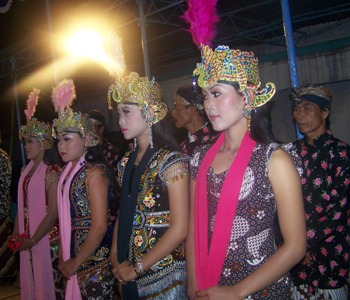 This traditional dance is a type of folk dance from Wonosobo, Central Java and surrounding. The dancers were men and there is a philosophy about this. This kind of dance has been known for almost one century in Central Java. This performance was initially pioneered in Giyanti village by traditional art fibure from Kecis village, Selomerto district, Mt Gondhowinangun 1910.
 The story of the performance starts when King Brawijaya lost his daughter Dewi Sekartaji. He held a contest that anyone could fine Dewi Sekartaji and brought her home will be rewarded to be the husband of Dewi Sekartaji if it was a man, and if it was a woman, she will be the sister of Dewi Sekartaji. This contest had many participants from knights all over the kingdom and surroundings. Two knights left to find the princes were Raden Panji Asmoro Bangun that under covered as Joko Kembang Kuning from Jenggala Kingdom. And the other one is Prabu Klono from Sebrang Kingdom that made the princess ran as she was arranged marriage with him by her father. In his search, Joko Kembang Kuning was accompanied by his guards, and they disguised as dancing troupe from place to place. The dancers was trans dress as female dancers in mask, with simple instruments. In every performance, people was so excited. And then later this performance is called as Lengger derives from ledek (dancer) and ger or geger means uproar. Until oneday, lengger performance could attract Dewi Sekartaji from her hiding place. But Prabu Klono found her existence first, and sent her sister Retno Tenggaron and soldiers to propose Dewi Sekartaji. But Dewi Sekartaji rejected him, and Retno Tenggaron and Dewi Sekartaji fought. Dewi Sekartaji won though.
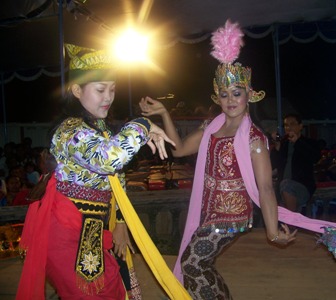 Prabu Klono and Joko Kembang Kuning felt they they found Dewi Sekartaji and asked for the reward to the king. King Brawijaya decided that both contestants should fight for the reward. In this final contest, Joko Kembang Kuning was represented by Tawang Alun Knight and he could kill Prabu Klono in that fight. In the end of this story, Joko Kembang Kuning and Dewi Sekartaji married in glorious wedding and entertained by lengger dance performance.
 Lengger dance survive until 21st century and performed by two dancers, the male dancer wears mask and the female dancer wears traditional costume as Javanese princess in the past. Every sequence is performed in 10 minutes with instrument of gambang, saron, kendang, gong, and other instrument.
 In Yogyakarta, loro blonyo statue is found easily, in someone’s house, in keraton, or in hotel. Loro blonyo is pair of statue, female and male, in cross-legged sitting pose, or other positions and they wear can wear Javanese costume. Sometimes they wear batik ,basahan style, or other costumes of Javanese.
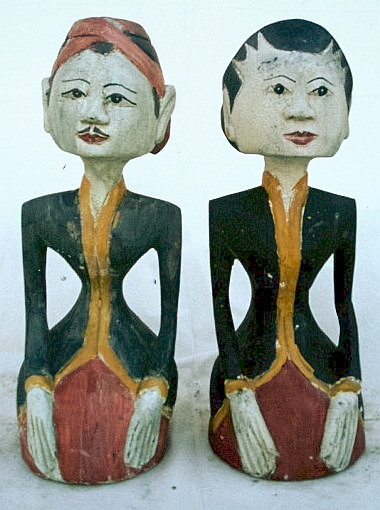 Loro blonyo is preserved culture that it still exists until today, in modern era. Loro blonyo is the representative of host, and can be put anywhere in the house, not only in the private room of the house owner. It can be put in living room, or dining room. Javanese believe that loro blonyo presence creates positive feel. As written various source that culture philosophy explains how human’s relation to nature, can be living things or non-living things and if cared well, there will be something good in return.